
Short answer: To answer SAT transition questions, cover the choices and label how the two sentences relate: contrast (however), cause (therefore), addition (moreover), example (for instance) or sequence (next). Then pick the one choice from that family. The wrong answers are almost always real transition words from the wrong family.
Transition questions look like vocabulary. They're not. They're logic questions wearing a vocabulary costume. Every choice is a perfectly good word. Only one of them describes how sentence 1 and sentence 2 actually connect.
On the Digital SAT, they look like this: a short text with a blank, and the question "Which choice completes the text with the most logical transition?"
What are the 5 families of SAT transition words?
Use this table like a flowchart. Read both sentences, decide which row you're in, and only then look at the choices.
| If sentence 2… | Family | Words to know |
|---|---|---|
| goes against what sentence 1 sets up | Contrast | however, nevertheless, still, yet, by contrast, in contrast, on the other hand, instead, conversely, even so |
| happens because of sentence 1 | Cause and effect | therefore, thus, consequently, as a result, hence, accordingly, for this reason |
| adds another point in the same direction | Addition | moreover, furthermore, in addition, additionally, also, likewise, similarly, indeed |
| is one specific case of sentence 1 | Example | for example, for instance, specifically, in particular |
| comes before or after it in time | Sequence | first, then, next, subsequently, later, finally, previously, meanwhile |
How do you pick the right transition in 10 seconds?
- Cover the choices. Read the sentence before the blank and the sentence after it.
- Label the link. Does sentence 2 push back, follow from, add to, zoom in on, or come after sentence 1?
- Match the family. Exactly one choice should be in that family. If two are, reread both sentences; one word will fit more precisely.
When is the answer "however"?
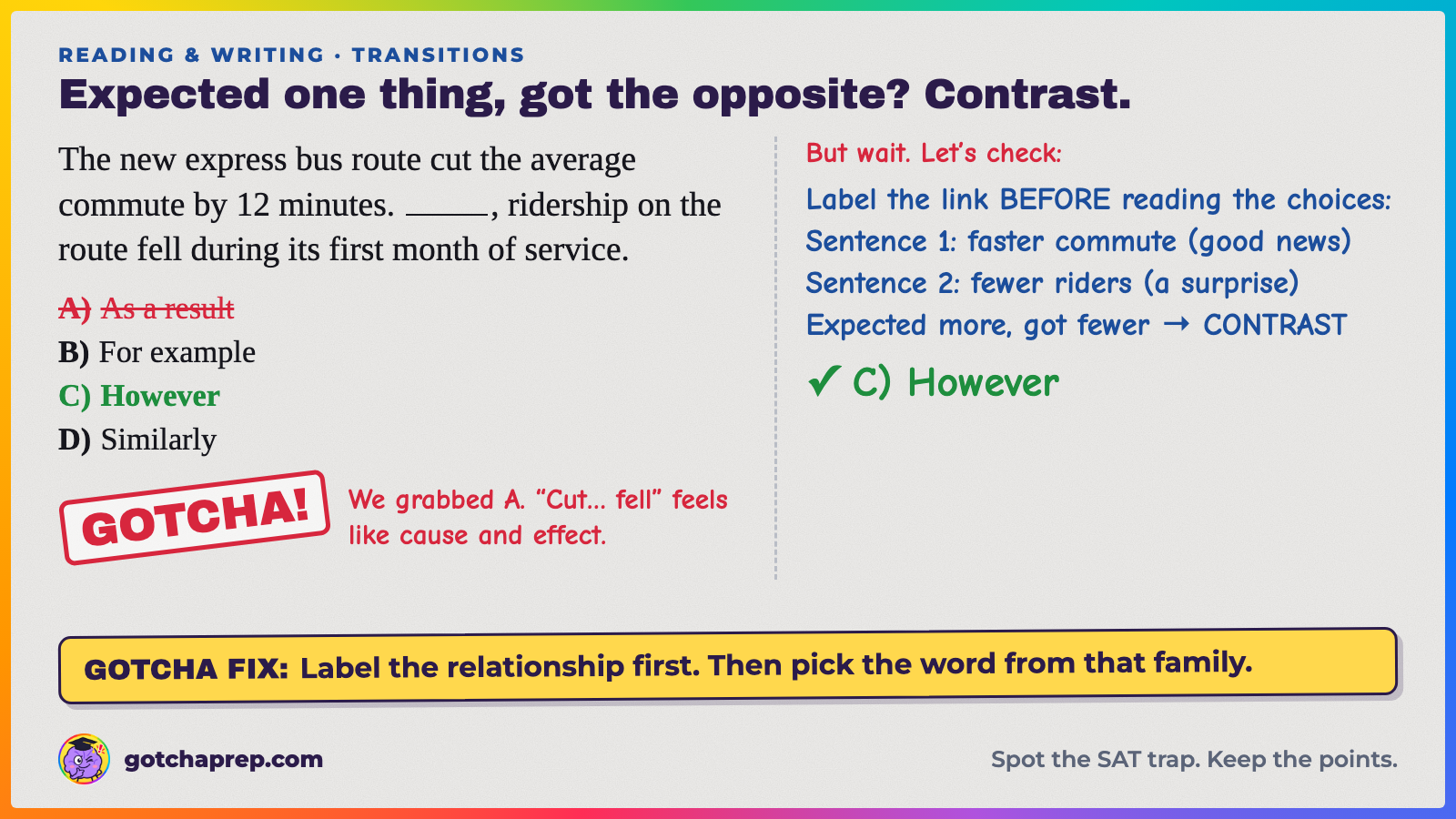
"Cut the commute… ridership fell." Two drops in a row feel like cause and effect, so we grab As a result. But wait. A faster bus should attract more riders. Sentence 1 sets up good news, and sentence 2 goes the other way. That's contrast: C) However.
Rule: Label the relationship first. Then pick the word from that family. See the transition words trap
How do you tell "for example" from "moreover"?
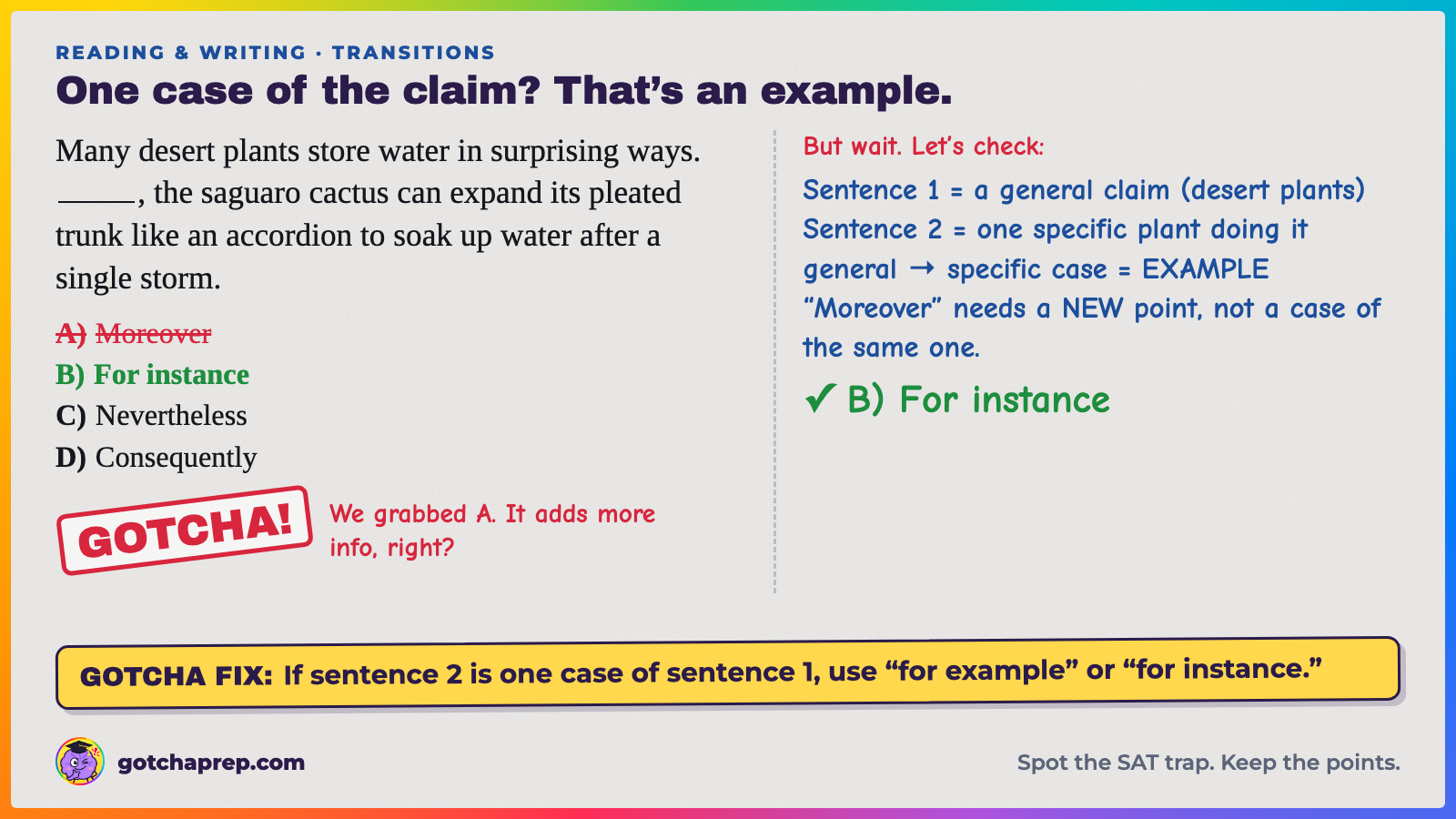
Moreover adds information, and sentence 2 is more information, so we grab it. But wait. Sentence 2 isn't a new point. It's one specific plant doing exactly what sentence 1 described. A general claim followed by a specific case is an example: B) For instance.
Moreover needs a new point in the same direction: "Many desert plants store water in surprising ways. Moreover, many have waxy skins that slow water loss."
Rule: If sentence 2 is one case of sentence 1, use "for example" or "for instance."
When is the answer "moreover" or "in addition"?
Use an addition word when sentence 2 makes a new point that pushes in the same direction as sentence 1:
The new library has twice as many study rooms as the old one. ___, it stays open until midnight.
Both sentences say the new library is better for studying, and neither one causes or fights the other. That's addition: Moreover, In addition or Furthermore all work. If sentence 2 said "it closes at 6 p.m.," the link would flip to contrast, and the answer would be However.
Rule: A new point in the same direction is addition.
How do you know a transition shows cause and effect?
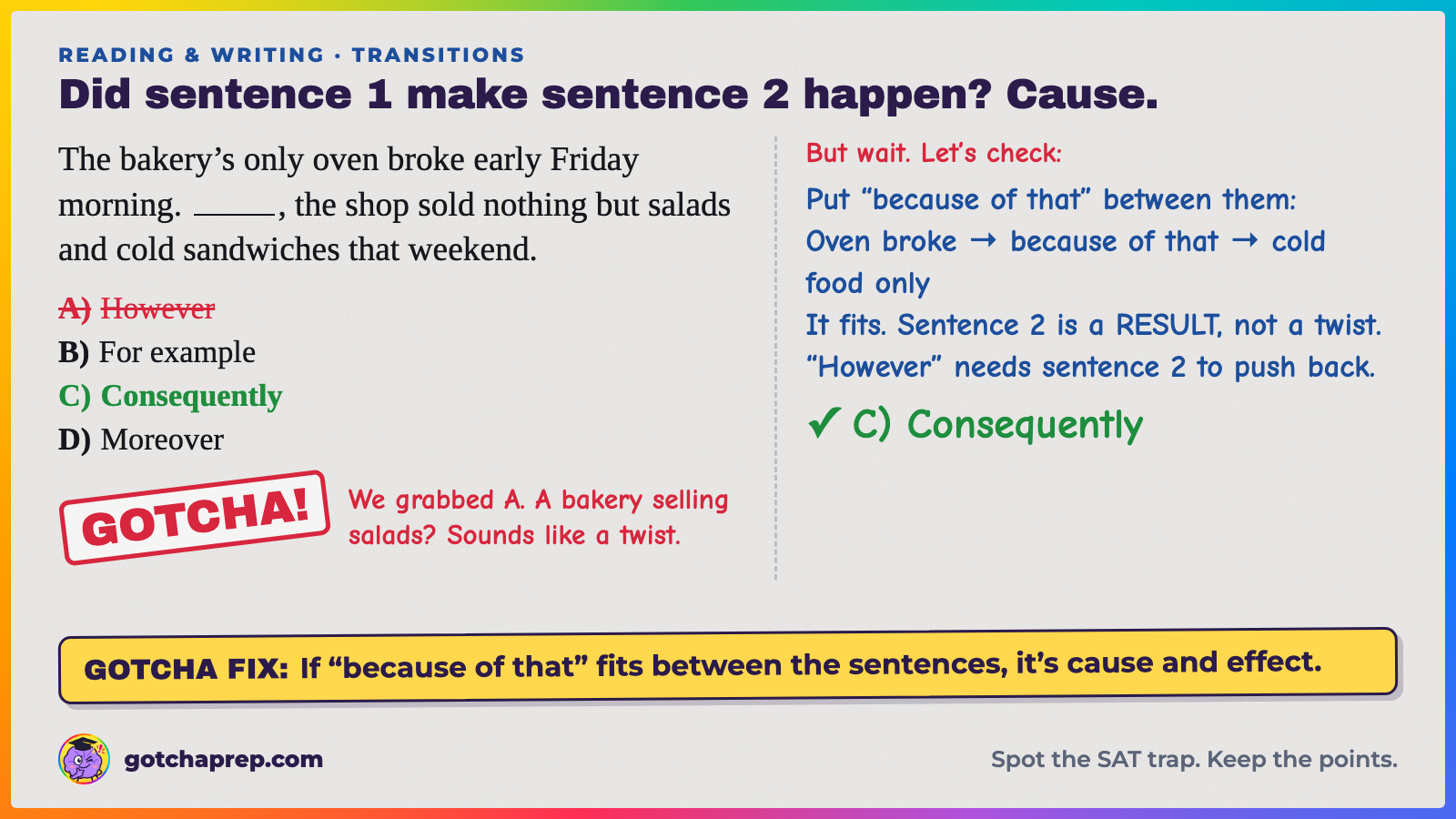
A bakery selling only salads and cold sandwiches? That sounds like a twist, so we grab However. But wait. Put "because of that" between the sentences: the oven broke, and because of that, the shop sold only cold food. It fits perfectly. Sentence 2 is the result of sentence 1: C) Consequently.
Rule: If "because of that" fits between the sentences, it's cause and effect.
Which sequence words are traps?
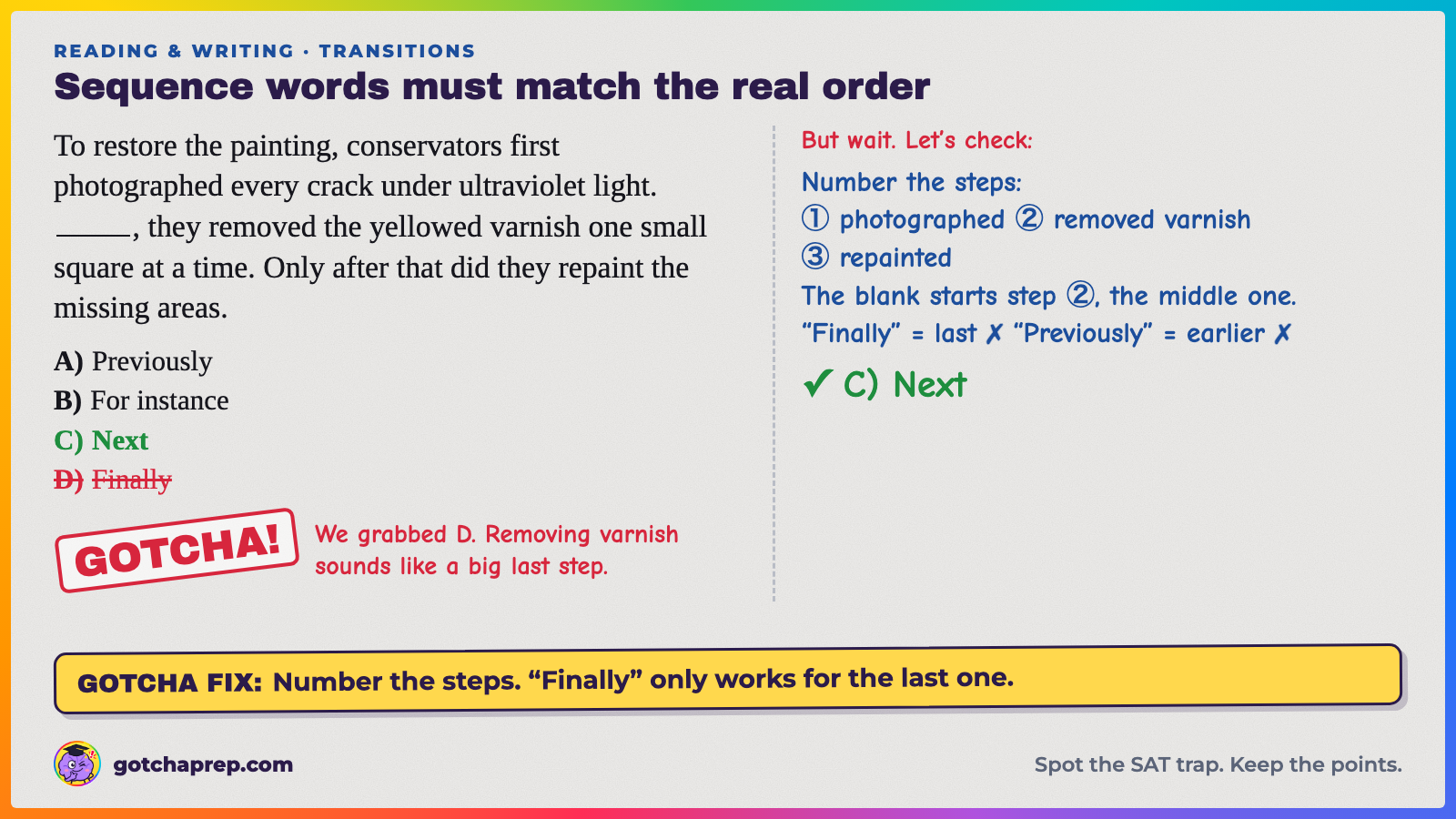
Removing the varnish sounds like a big final step, so we grab Finally. But wait. Number the steps: ① photograph the cracks, ② remove the varnish, ③ repaint. The blank starts step ②, and the text says something still comes after it. Finally means last, and Previously means earlier. The middle step gets C) Next.
Rule: Number the steps. "Finally" only works for the last one.
What if two choices are in the same family?
The SAT rarely offers two words that both fit. When two choices look like the same family, check the exact job each one does:
- However flips an expectation. In contrast compares two different things: "Lions often hunt in groups. In contrast, tigers hunt alone."
- Nevertheless and still mean "despite that": sentence 2 happens anyway.
- Instead means a replacement: one thing happened in place of another.
- Similarly and likewise need a real match between two things, not just more information.
What else do students ask about SAT transition words?
Is "however" always a contrast word?
On SAT transition questions, yes. However signals that sentence 2 goes against what sentence 1 set up. Outside transitions it can also mean "in whatever way," as in "However you study, be consistent."
Do transition words need a comma or a semicolon?
At the start of a sentence, a transition like however takes a comma after it. Between two complete sentences, put a semicolon before it and a comma after: "The bus got faster; however, ridership fell." Transition questions usually give you the punctuation, but grammar questions test it. See the semicolon trap.
What's the most common SAT transition trap?
A formal-sounding word from the wrong family. Therefore and as a result sound smart, so they tempt you even when sentence 2 is a surprise. Label the link first and the trap stops working.
Where can you get the full SAT trap cheat sheet?
The free SAT Gotcha Sheet has the transition trap plus 29 more, each with the tempting wrong answer, the right answer and the 3-second fix. Get the free SAT Gotcha Sheet
Want a new trap every day? Subscribe to Gotcha Prep on YouTube, and take the 10-question SAT trap quiz to see which families still trip you up.
One rule to remember: label the link before you read the choices.
Gotcha Prep is not affiliated with College Board. SAT® is a trademark registered by College Board, which does not endorse this article. All practice questions are original.