
Short answer: Almost every SAT percent question comes down to one move: turn the percent into a multiplier and multiply. 20% off is × 0.80, 25% more is × 1.25, and 10% growth for 3 years is × 1.10³. The traps tempt you to add percents, cancel them, or divide by the wrong number.
Percent questions look like free points. That's exactly why they're dangerous. Let's fall for each of the five classic traps once, so we never fall for them again.
What's the fastest way to do SAT percent questions?
Turn every percent change into a multiplier:
- Increase by p%: multiply by (1 + p/100). Up 25% is × 1.25.
- Decrease by p%: multiply by (1 − p/100). Down 20% is × 0.80.
- p% of something: multiply by p/100. 15% of 60 is 0.15 × 60 = 9.
Two changes in a row? Multiply both multipliers. A whole chain of changes is one multiplication. And when a question gives no starting number, pick $100, because percents of 100 are just the numbers themselves.
Try it on a chain. A $50 shirt is marked up 20% and then discounted 10%: $50 × 1.20 × 0.90 = $54, so it ends $4 above where it started. And "20% of 30%" is 0.20 × 0.30 = 0.06, which is 6%, not 50% and not 10%.
Why don't stacked percents add up?
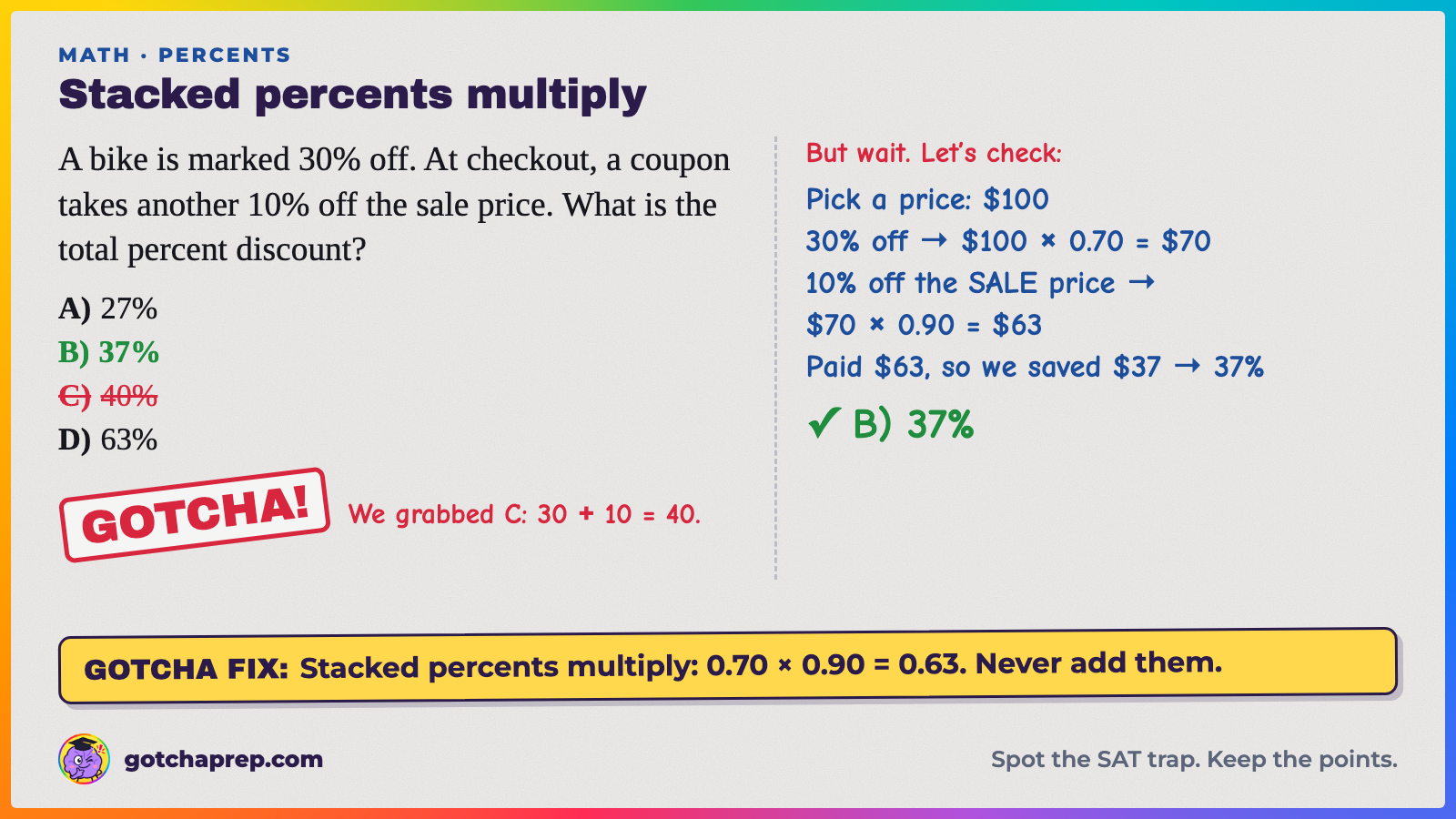
30% off, then 10% off. 30 + 10 = 40, so we grab 40%. But wait. The coupon takes 10% off the sale price, not the original. Pick a price: $100 becomes $70 after the first discount and $63 after the coupon. We paid $63, so we saved $37. The total discount is B) 37%.
Rule: Stacked percents multiply: 0.70 × 0.90 = 0.63. Never add them. Percent of a percent
Is "up 25%, then down 25%" back where you started?
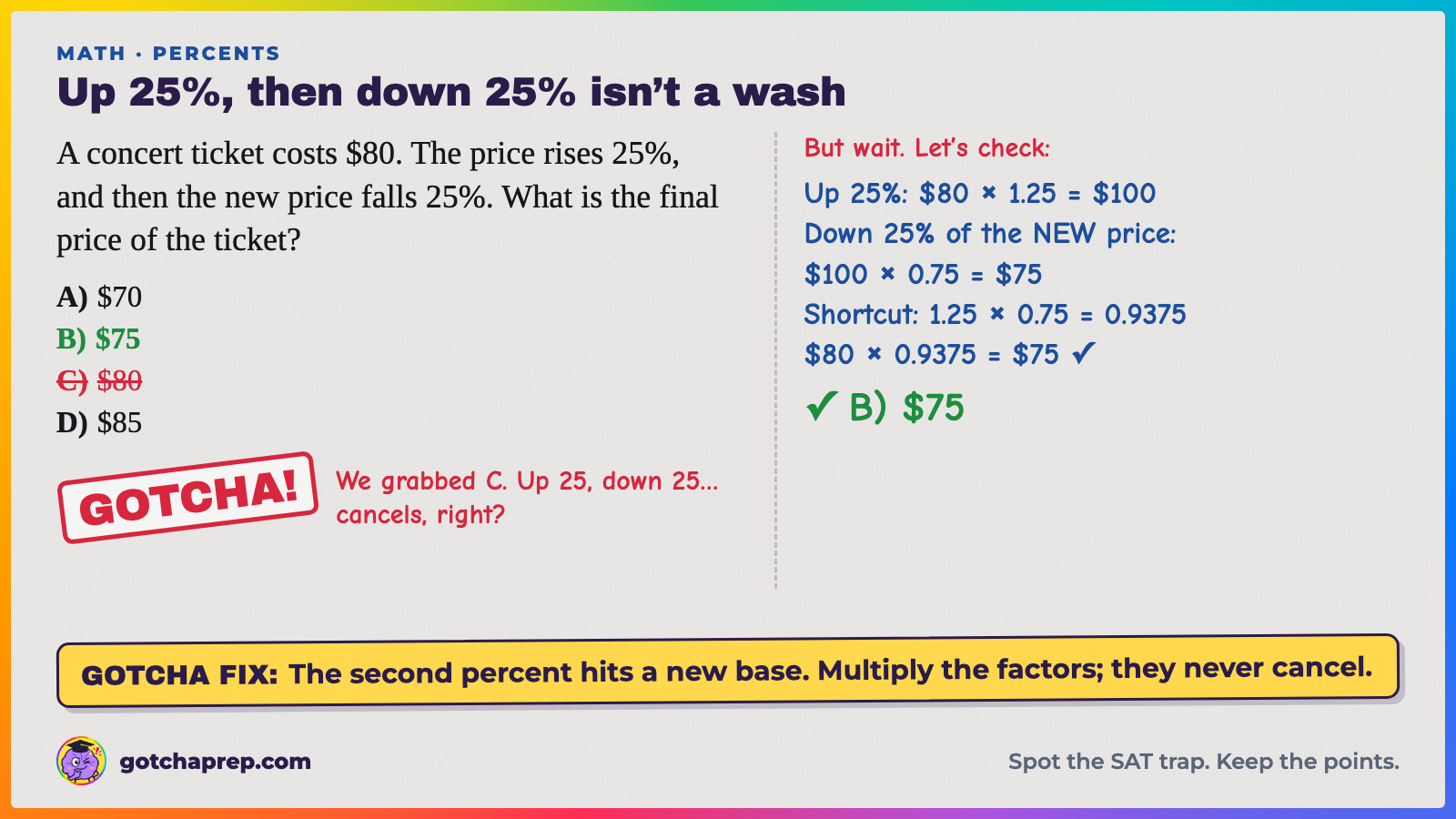
Up 25, down 25. That cancels, right? So the ticket is back to $80. But wait. The 25% drop is taken from the new price. $80 × 1.25 = $100, and then $100 × 0.75 = $75. The answer is B) $75.
Here's the shortcut: 1.25 × 0.75 = 0.9375, so the ticket ends 6.25% lower. Any rise and fall by the same percent leaves you below where you started. A 50% rise and then a 50% drop leaves 1.5 × 0.5 = 0.75 of the original, a 25% loss.
Rule: The second percent hits a new base. Multiply the factors; they never cancel. Up 25%, down 25%
What's the difference between "percent of" and "percent more than"?
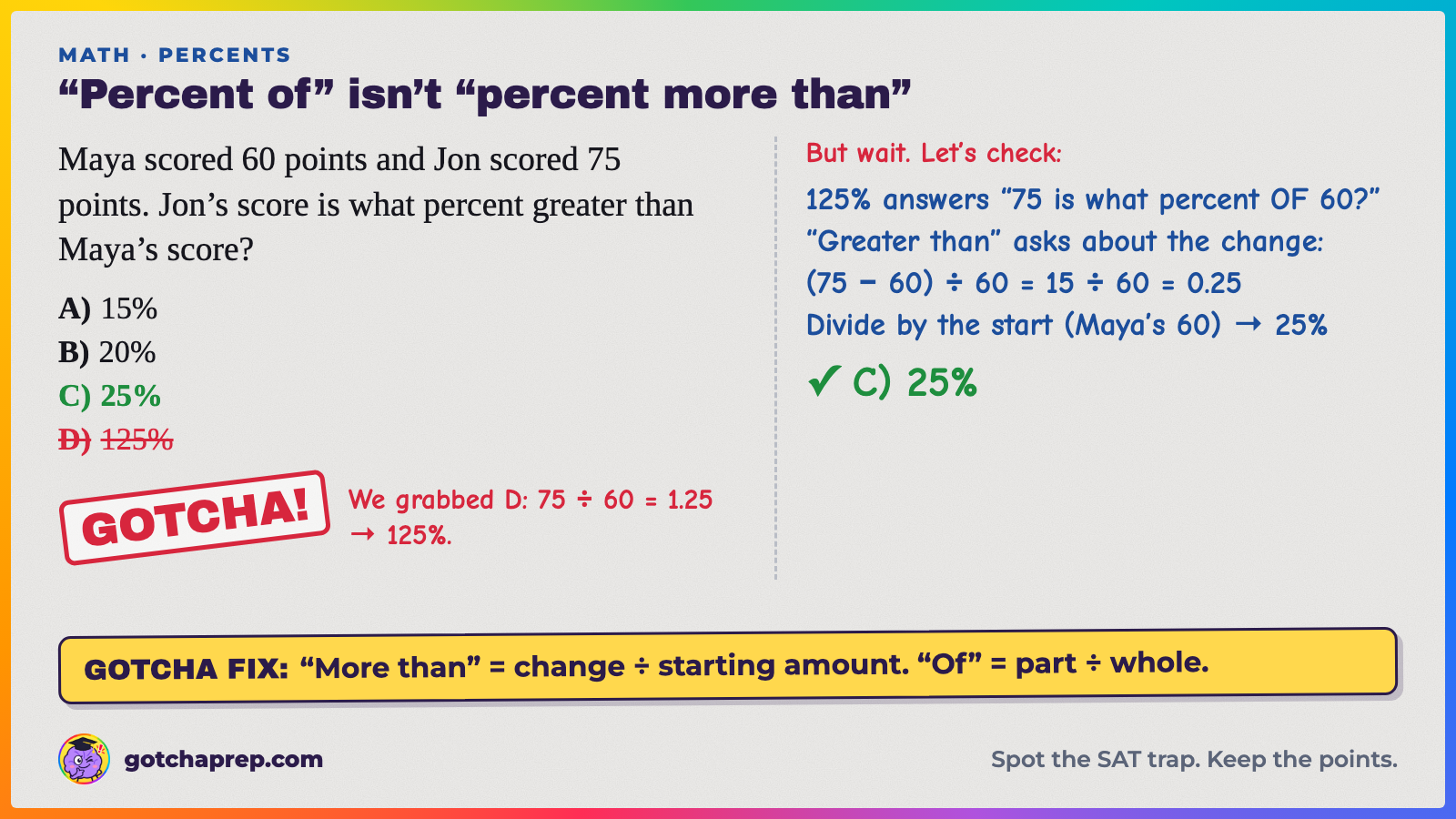
75 ÷ 60 = 1.25, so 125%. Done? But wait. 125% answers a different question: "75 is what percent of 60?" This question asks what percent greater, which is about the change: (75 − 60) ÷ 60 = 15 ÷ 60 = 0.25. Jon's score is C) 25% greater.
The other tempting choice, 20%, divides by the wrong base (15 ÷ 75). That answers "Maya's score is what percent less than Jon's?" Same 15-point gap, different starting amount.
Rule: "More than" = change ÷ starting amount. "Of" = part ÷ whole.
How do you find the original price after a discount?
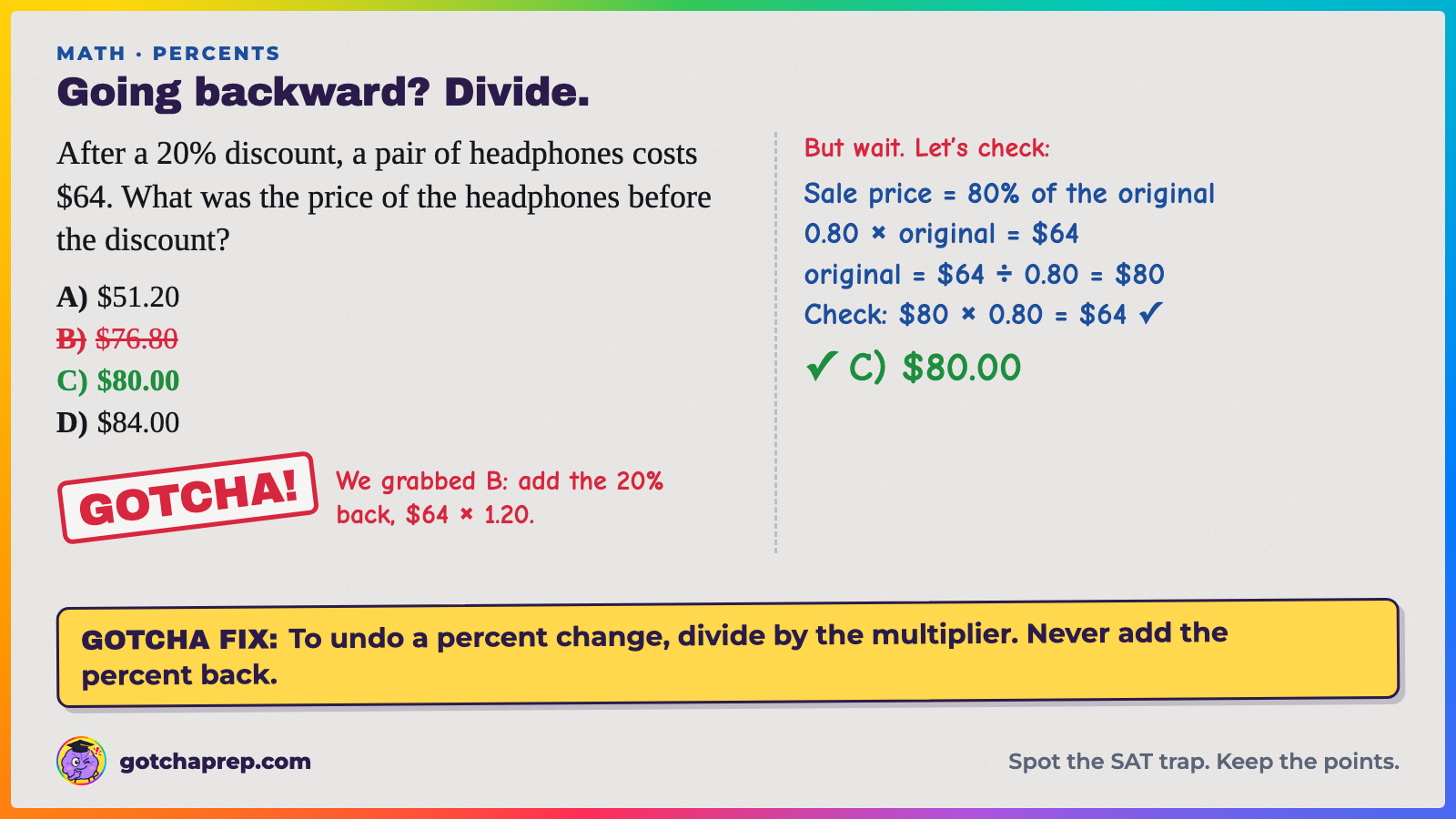
The price dropped 20%, so let's add 20% back: $64 × 1.20 = $76.80. But wait. The 20% came off the original price, and we don't know that yet. The sale price is 80% of the original, so 0.80 × original = $64, and the original is $64 ÷ 0.80 = C) $80.00. Check: 20% of $80 is $16, and $80 − $16 = $64.
Rule: To undo a percent change, divide by the multiplier. Never add the percent back.
How do you spot exponential growth in a percent question?
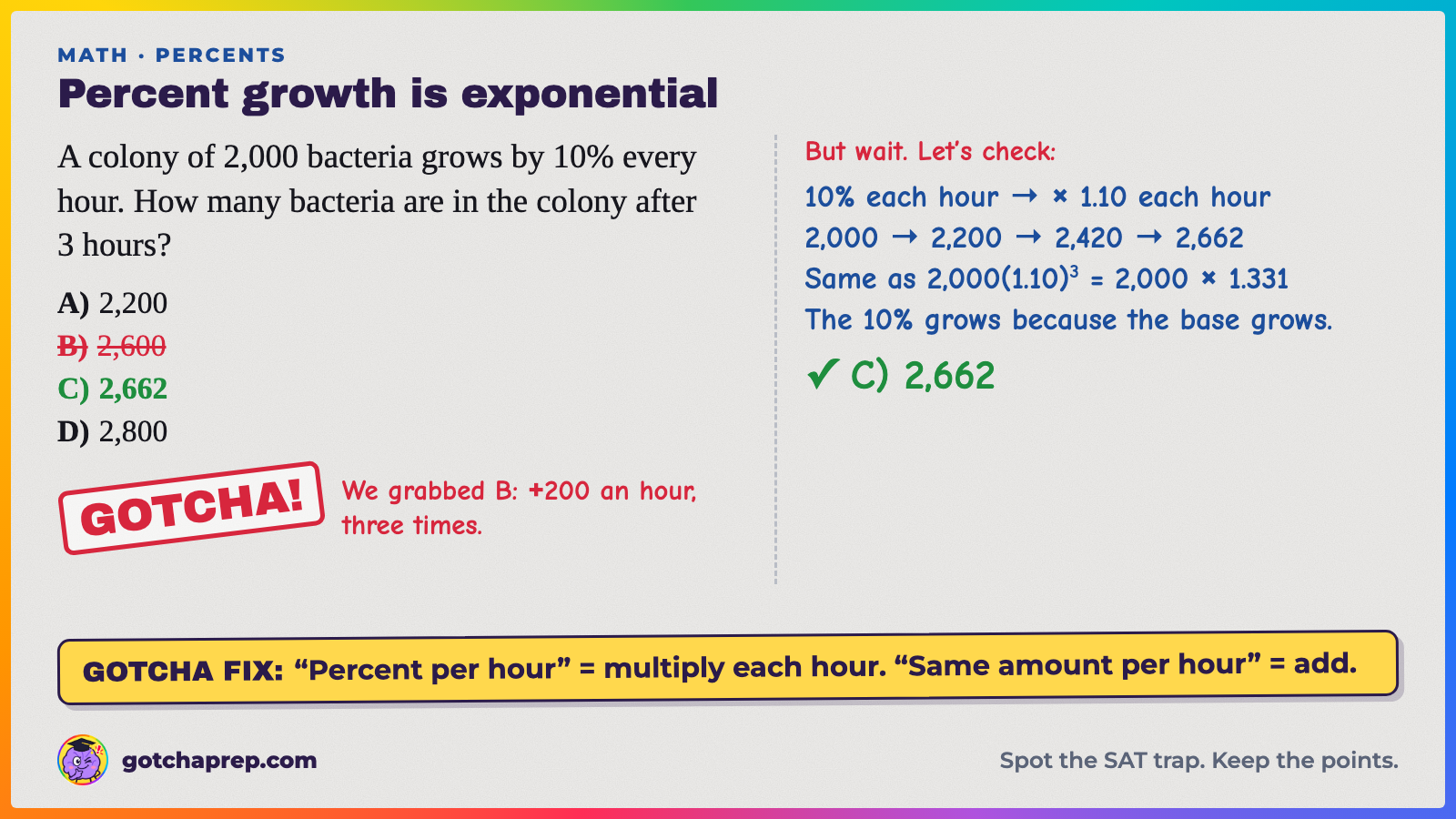
10% of 2,000 is 200, so add 200 three times and get 2,600. But wait. After the first hour, the next 10% is taken of 2,200, not 2,000. The colony grows 2,000 → 2,200 → 2,420 → 2,662. That's 2,000(1.10)³ = 2,000 × 1.331 = C) 2,662.
The model behind it is f(t) = 2,000(1.10)ᵗ. A percent change each period means exponential growth. The same amount each period, like +200 per hour, means linear growth.
Decay works the same way with (1 − r). A $20,000 car that loses 15% of its value each year is worth $20,000 × 0.85² = $14,450 after 2 years, not $20,000 − 2($3,000) = $14,000.
Rule: "Percent per hour" means multiply each hour. "Same amount per hour" means add. Percent growth is exponential
Can Desmos check a percent question?
Yes, in seconds. Type 100*0.7*0.9 and Desmos prints 63. For growth, type 2000(1.1)^3 and it prints 2662. To see the whole curve, graph y=2000(1.1)^x. More moves are on our Desmos page.
What else do students ask about SAT percent questions?
How do you calculate percent change on the SAT?
Percent change = (new − original) ÷ original × 100. From 60 to 75, that's (75 − 60) ÷ 60 × 100 = a 25% increase. Always divide by the original, the "before" number.
Is a 50% increase followed by a 50% decrease the same as no change?
No. 1.5 × 0.5 = 0.75, so you end 25% below where you started. A rise and a fall by the same percent never cancel. Different percents can: up 25% and then down 20% gives 1.25 × 0.80 = 1, which is exactly where you started.
What's the exponential growth formula on the SAT?
f(t) = a(1 + r)ᵗ, where a is the starting amount, r is the rate as a decimal, and t is the number of periods. For decay, use (1 − r). A town of 1,000 people growing 5% a year has 1,000(1.05)³ ≈ 1,158 people after 3 years.
Where can you practice more SAT percent traps?
The free SAT Gotcha Sheet has 15 math traps, including the stacked-percent, up-and-down and percent-growth traps from this post, each with its 3-second fix. Get the free SAT Gotcha Sheet
Then subscribe to Gotcha Prep on YouTube for a new trap explained in under a minute, and try the 10-question SAT trap quiz to see which ones still get you.
One rule to remember: percents multiply. The moment you add them, the trap wins.
Gotcha Prep is not affiliated with College Board. SAT® is a trademark registered by College Board, which does not endorse this article. All practice questions are original.