
Short answer: The SAT grammar rules that cost the most points are about where sentences start and stop. A semicolon needs a complete sentence on both sides, a colon needs a complete sentence before it, and a comma alone can't join two sentences. Add matching dashes and commas around extra information, its vs. it's, plural apostrophes, and subject–verb agreement, and you have the core of the Digital SAT's grammar questions.
Grammar questions don't feel hard. The wrong answer usually sounds fine. That's the trap. So let's fall for each one once, catch it, and keep a one-line rule.
On the Digital SAT, these questions show a short text with a blank and ask, "Which choice completes the text so that it conforms to the conventions of Standard English?" College Board's test specifications put these Standard English Conventions questions at about a quarter of the Reading and Writing section.
When can you use a semicolon on the SAT?
A semicolon is a period in disguise. If a period can't go there, neither can a semicolon.
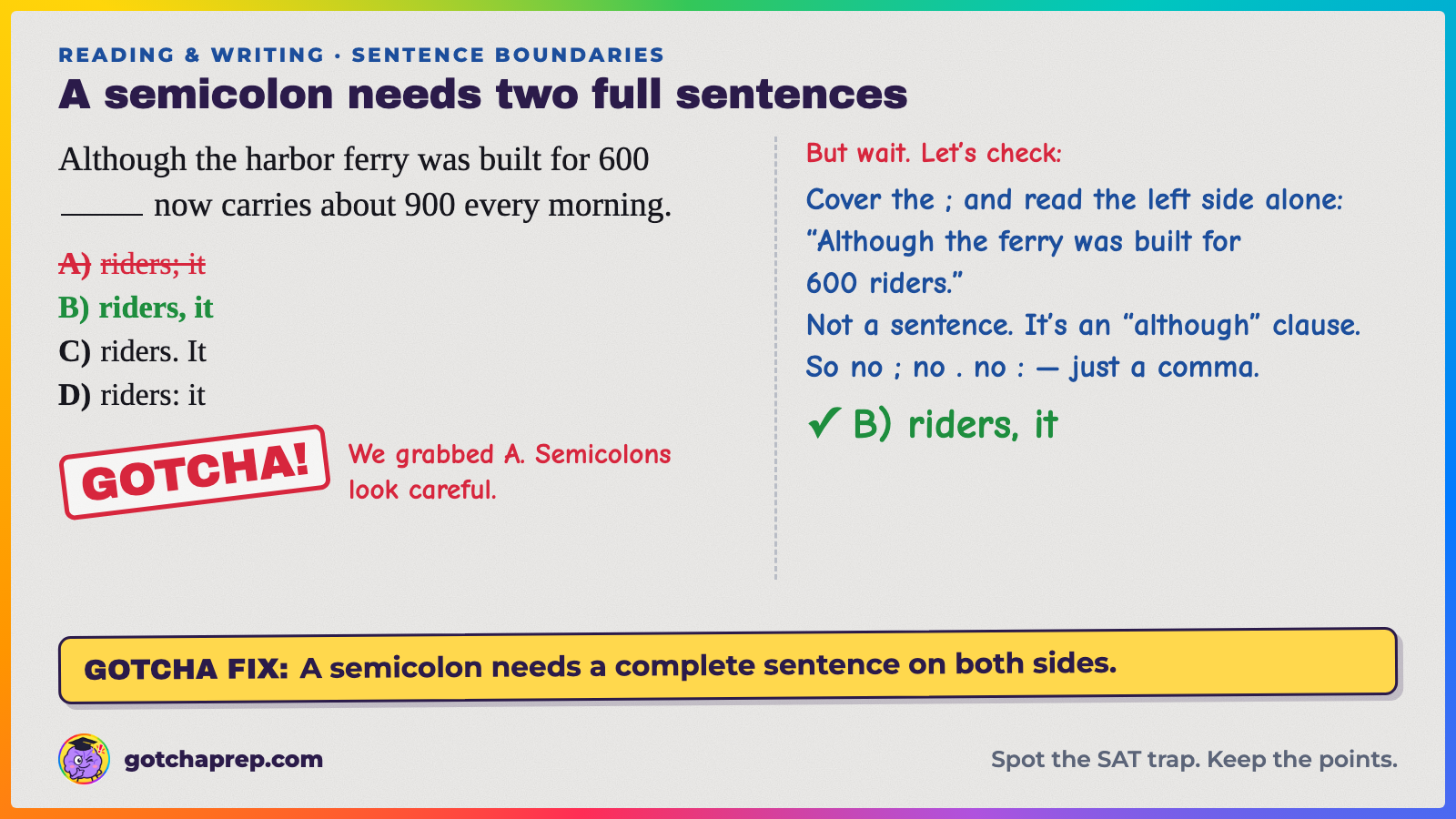
We grab the semicolon. It looks careful. But wait. Cover the semicolon and read the left side alone: "Although the harbor ferry was built for 600 riders." That's not a sentence. It's an although clause waiting for its main clause. So no semicolon, no period, no colon. Just a comma: B) riders, it.
Rule: A semicolon needs a complete sentence on both sides. Practice the semicolon trap
Why is a comma splice wrong?
A comma splice is two complete sentences glued together with only a comma:
The bakery opens at 6 a.m., the line starts at 5:30.
Both halves stand alone, so a comma can't hold them together. Three fixes work: a period ("6 a.m. The line…"), a semicolon ("6 a.m.; the line…"), or a comma plus a joining word, one of for, and, nor, but, or, yet, so ("6 a.m., but the line…").
Watch for the sneaky version. "The bakery opens at 6 a.m., however, the line starts at 5:30" is still a splice, because however isn't one of those seven joining words. Write "6 a.m.; however, the line starts at 5:30."
Rule: A comma alone never joins two sentences. See the comma splice trap
What has to come before a colon?
A colon can introduce a list, an explanation or a quotation, but only after a complete sentence.
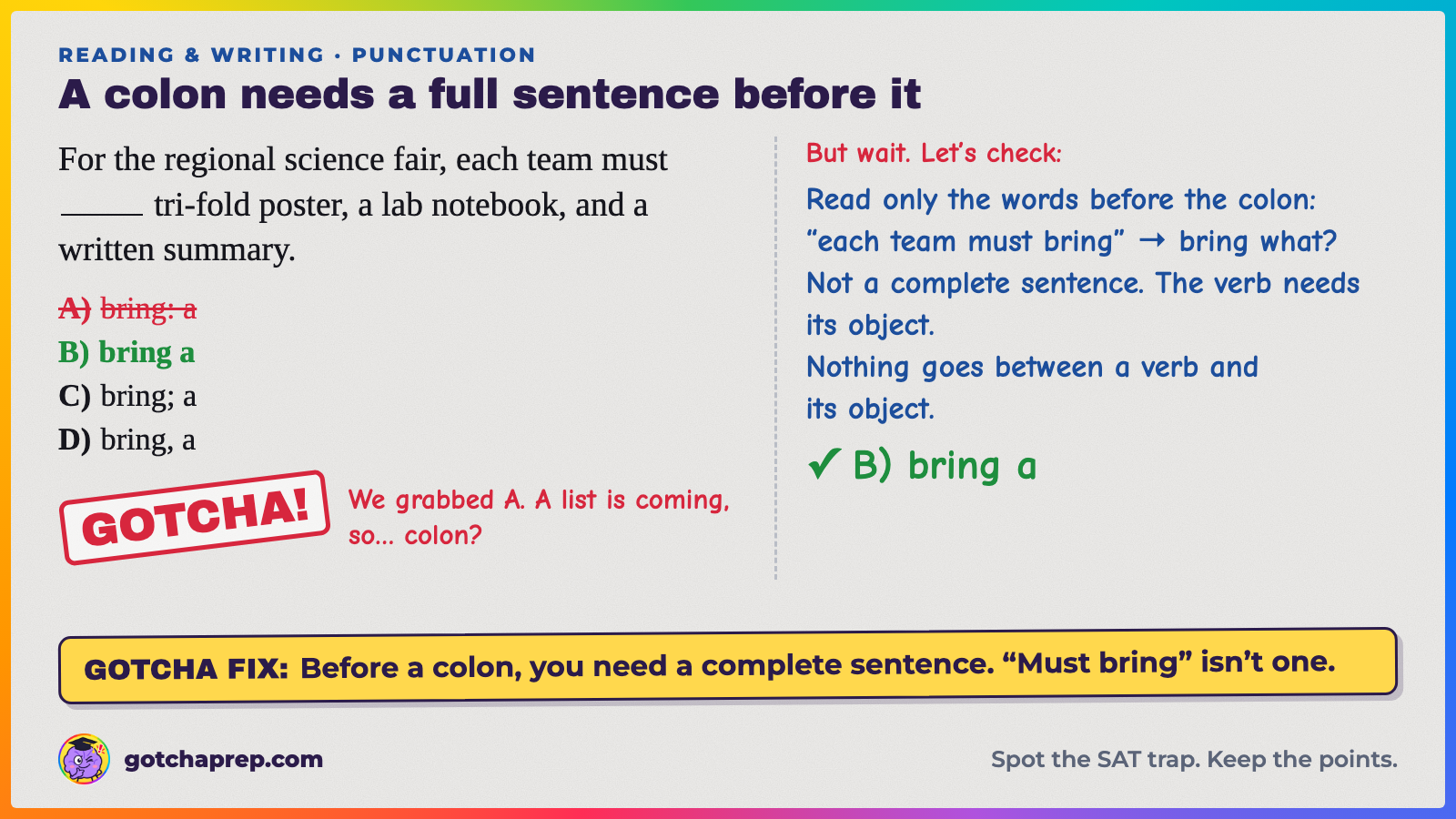
A list is coming, so we reach for the colon. But wait. Read only the words before it: "each team must bring." Bring what? Not a complete sentence. Nothing goes between a verb and its object, so the answer is B) bring a, with no punctuation.
Want the colon? Finish the sentence first: "Each team must bring three things: a tri-fold poster, a lab notebook, and a written summary."
Rule: Before a colon, you need a complete sentence. See the colon trap
How do dashes and commas work around extra information?
Extra information, a detail you could delete without breaking the sentence, gets a matching pair of marks: two commas, two dashes or two parentheses. The SAT opens with one mark and tempts you to close with another.
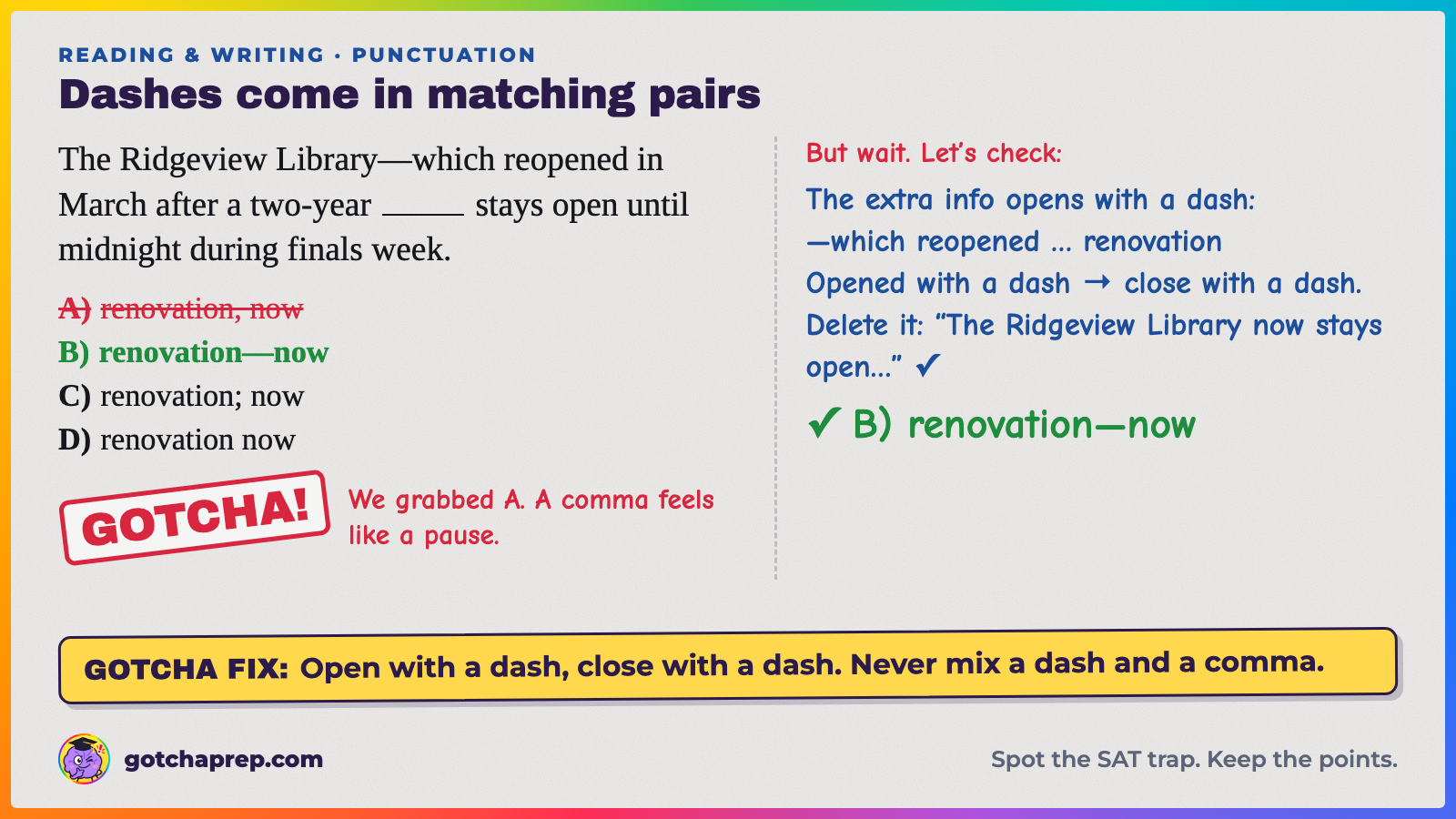
The comma feels like a natural pause, so we grab it. But wait. The extra information opened with a dash, so it has to close with a dash. Test it by deleting the extra part: "The Ridgeview Library now stays open until midnight." The answer is B) renovation—now.
The comma version of this trap is just as common:
My cousin, a pilot for twelve years___ flies to Tokyo twice a month.
It opened with a comma, so it closes with one: "years, flies." But if the information is essential, telling you which one, use no commas: "The poet Maya Angelou wrote seven autobiographies."
Rule: Match the pair. Open with a dash, close with a dash. Open with a comma, close with a comma. Dash pairs · Extra-info commas
Its or it's? How do apostrophes work on the SAT?
Two quick rules cover most apostrophe questions.
First, it's always means "it is" or "it has." Its, with no apostrophe, is possessive, like his or hers. Say "it is" in the blank: "The club changed it is logo"? Sounds wrong, so the answer is its.
Second, plural and possessive are two separate questions.
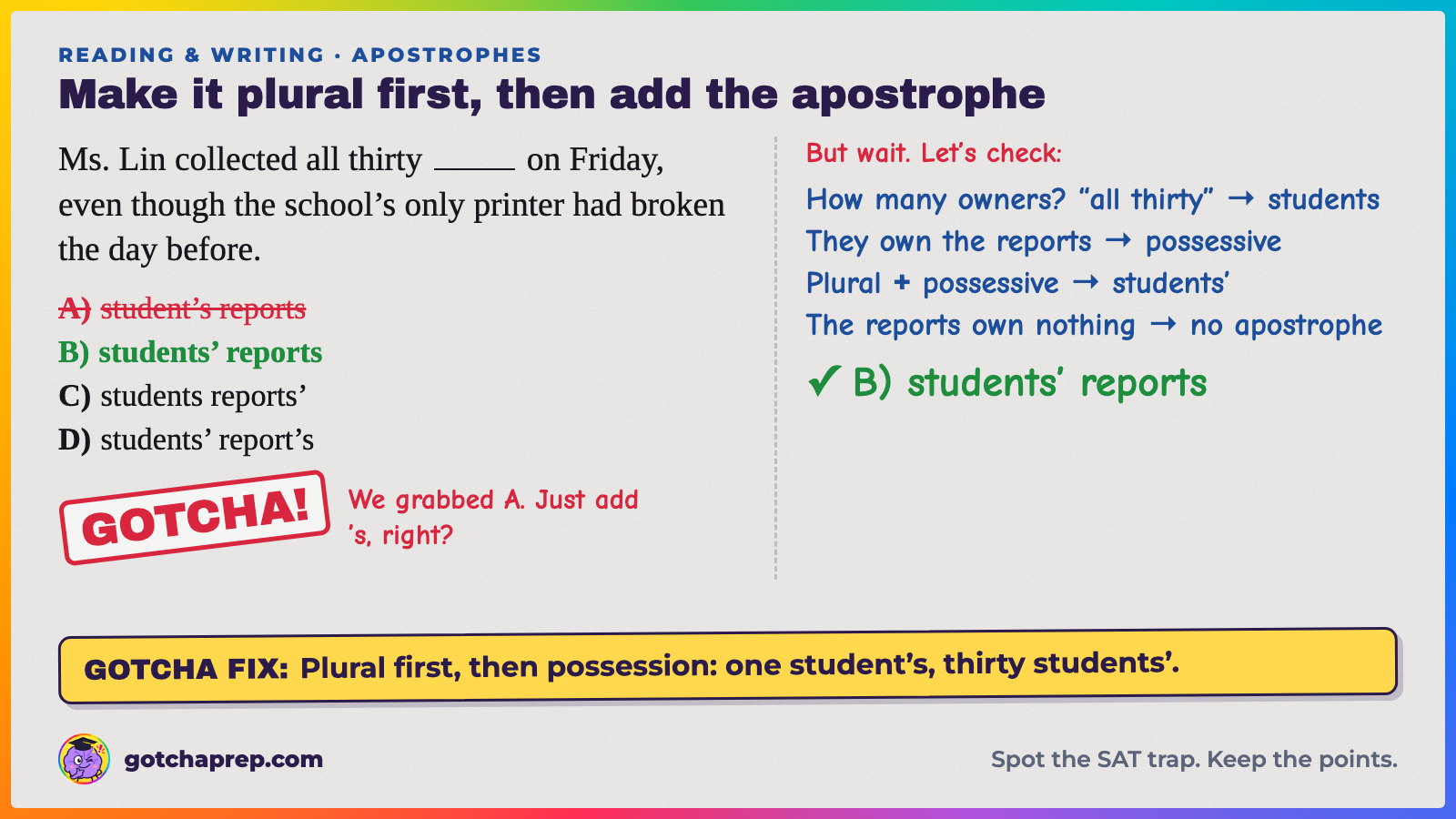
We grab "student's" because apostrophe-s feels like the default. But wait. Ask two questions. How many owners? "All thirty," so students. Do they own something? Yes, the reports, so the word is possessive: students'. The reports don't own anything, so they get no apostrophe. The answer is B) students' reports.
Rule: Plural first, then possession: one student's, thirty students'. See the its/it's trap
How do you find the real subject for subject–verb agreement?
The SAT hides the subject behind a long phrase, so the nearest noun sounds like the subject.
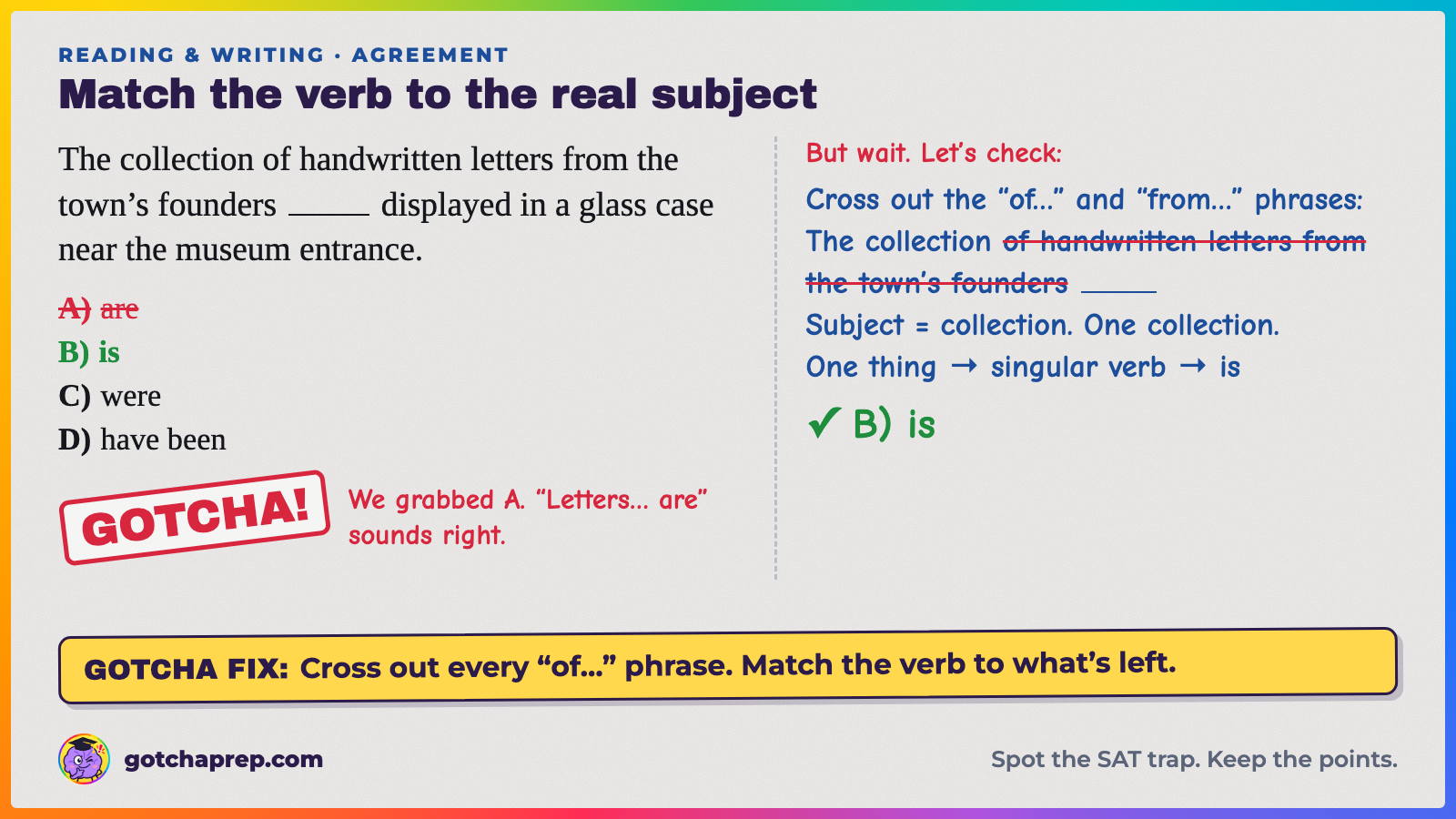
"Letters… are" sounds right, so we grab it. But wait. Cross out the "of…" and "from…" phrases: "The collection ___ displayed." One collection, so the verb is singular. The answer is B) is.
Pronouns work the same way: a company, team or club is one thing, so it takes its, not their.
Rule: Cross out every "of…" phrase. Match the verb to what's left. Subject–verb agreement · Pronoun agreement
What's the fastest way to check any SAT grammar question?
The Gotcha Sheet's 3-second grammar check:
- Find the real subject and verb.
- Mark where each complete sentence ends.
- Two choices both grammatical? Pick the shorter one.
"Sounds okay" is how the trap gets you. Structure is how you get the point back.
What else do students ask about SAT grammar rules?
Does the Digital SAT still test grammar?
Yes. Every Reading and Writing module includes Standard English Conventions questions on punctuation, agreement, verb forms and possessives. They're some of the fastest points on the test.
Can a semicolon come before "however"?
Yes, when however starts a new complete sentence: "The test was hard; however, I finished early." If however only interrupts one sentence, use commas: "The test, however, was short."
How many grammar rules do I need for the SAT?
Fewer than you think. The eight in this post, plus pronoun agreement, verb tense and modifiers, cover the patterns that keep coming back.
Where can you get every SAT trap on one page?
Grab the free SAT Gotcha Sheet: 30 traps, each with the tempting wrong answer, the right answer and the 3-second fix, plus 5 Desmos cheat codes. Get the free SAT Gotcha Sheet
Want one trap a day in under 60 seconds? Subscribe to Gotcha Prep on YouTube, then test yourself with the 10-question SAT trap quiz.
One rule to remember: "sounds fine" isn't a rule. Find where each sentence ends.
Gotcha Prep is not affiliated with College Board. SAT® is a trademark registered by College Board, which does not endorse this article. All practice questions are original.