
Short answer: The most efficient way to study for the SAT is a 10-minute daily loop: log every question you miss, name the trap that got you, and fix it with a one-line rule you re-test two days later. Add a full Bluebook practice test at the start, middle and end of a 3-week plan, and you'll stop missing the same kind of question twice.
Here's the uncomfortable truth. Most of us "study" by doing more questions, then miss the same kinds of questions on different days. More reps of a mistake isn't practice. It's rehearsal.
So let's flip it. We won't do more. We'll miss less.
Why does 10 minutes a day work for the SAT?
Because most lost points come from a small set of repeat traps, not brand-new material: adding stacked percents, forgetting to flip an inequality, grabbing the semicolon because it looks careful. Ten focused minutes on your repeat traps beats an hour of questions you already know how to do. And ten minutes fits every day, even on a school night.
What is an SAT miss log?
A miss log is one line per missed or guessed question, in a notebook or notes app. Each line has five parts:
- Where: test, module and question number.
- What happened: your pick and the right answer.
- Trap name: two to five words, your own.
- Fix: the one-line rule that would have saved you.
- Re-test date: two days out.
Example: "Practice test, Math module 2, #14 · picked 5, answer 11 · solved for x, not what they asked · reread the last line before clicking · re-test Thursday."
How do you name the trap?
Naming is the step everyone skips, and it's the one that matters. "Careless mistake" is not a name. "Divided by a negative and didn't flip" is, because it tells you what to watch for. Here are four entries.
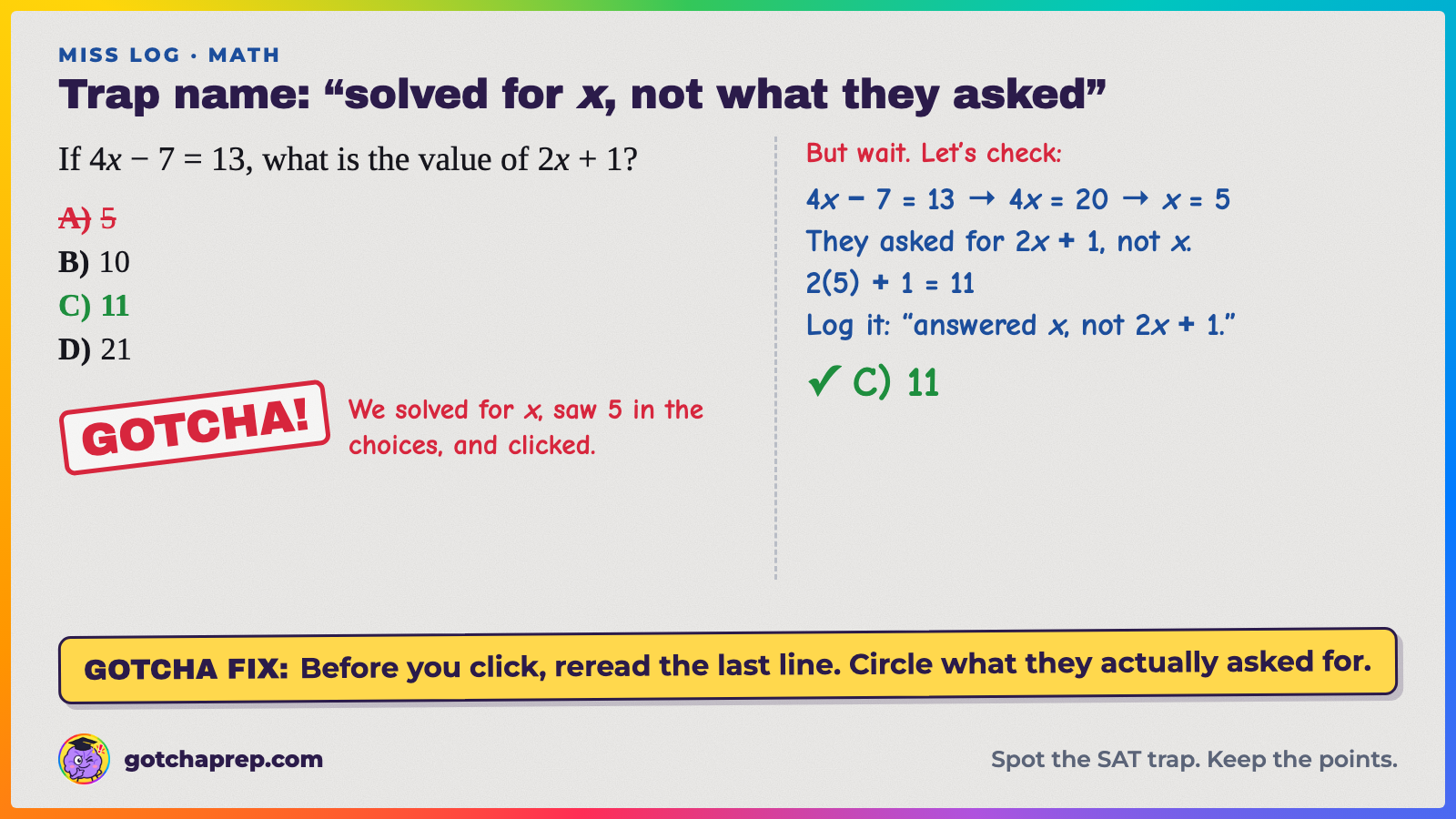
We solved 4x − 7 = 13, got x = 5, saw 5 in the choices and clicked. But wait. They asked for 2x + 1, and 2(5) + 1 = C) 11. Trap name: solved for x, not what they asked. Fix: reread the last line before you click. Answer the question they asked
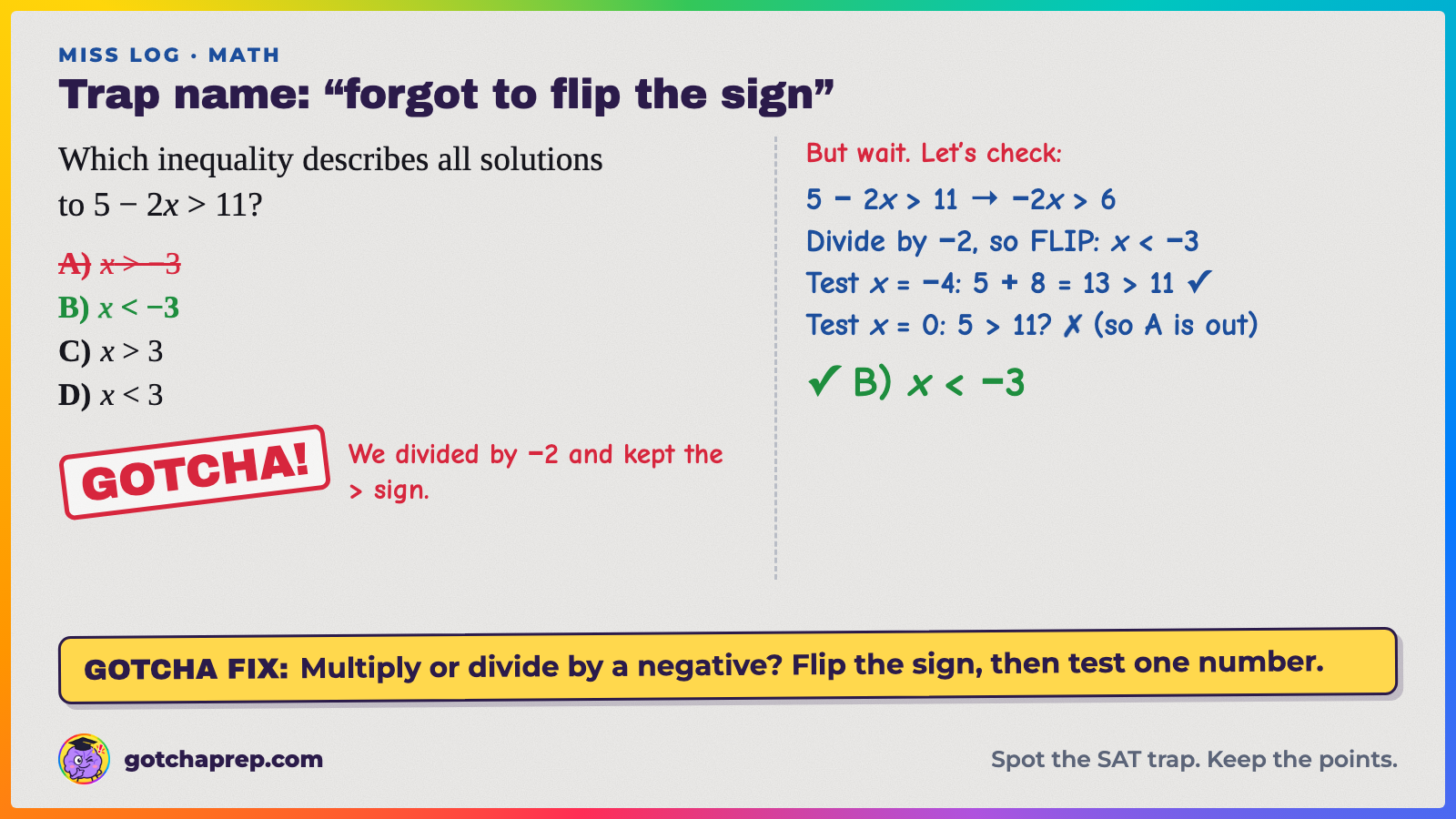
5 − 2x > 11 becomes −2x > 6. We divide by −2 and write x > −3. But wait. Dividing by a negative flips the sign: B) x < −3. Test x = −4: 5 + 8 = 13, and 13 > 11. Trap name: forgot to flip the sign. Negative flips the inequality
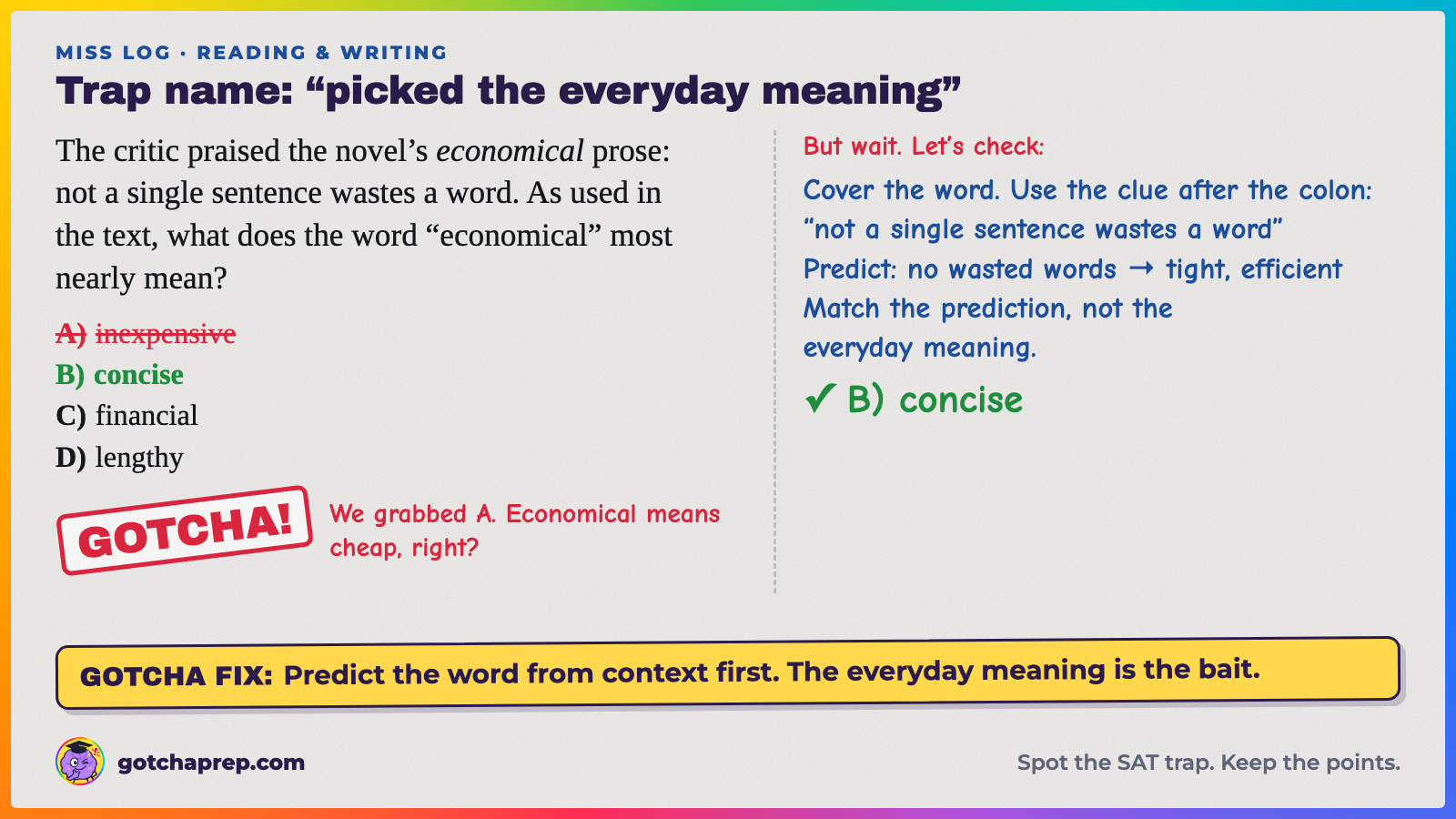
"Economical" means cheap, right? But wait. The clue after the colon says no sentence wastes a word. Economical prose is tight and efficient: B) concise. Trap name: picked the everyday meaning. Words in context
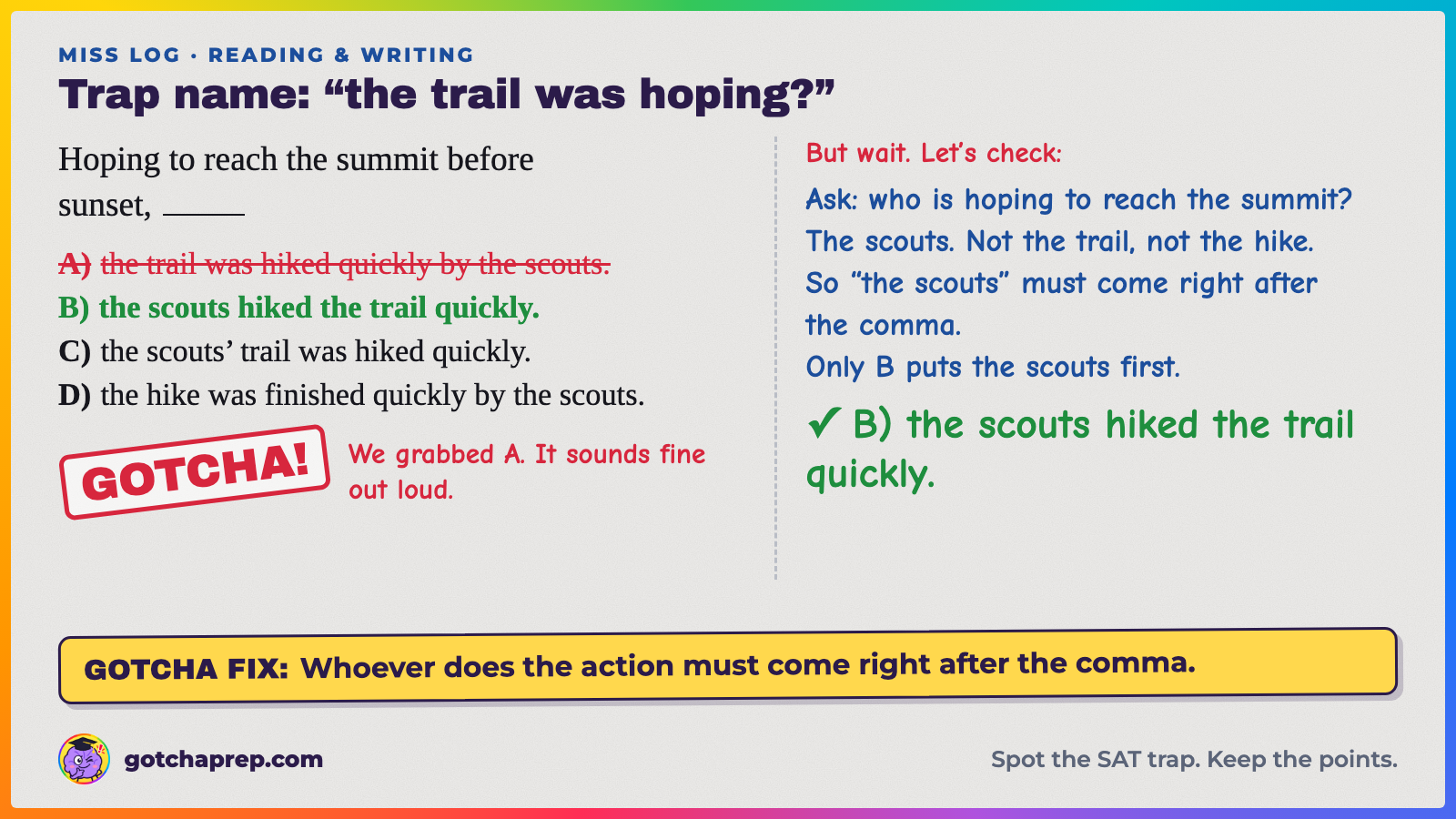
Choice A sounds fine out loud. But wait. Who is hoping to reach the summit? The scouts, not the trail. So the scouts have to come right after the comma: B) the scouts hiked the trail quickly. Trap name: the trail was hoping? Dangling modifier
How do you make a fix stick?
Two days after a miss, redo the question cold, without your notes. Then do one fresh question with the same trap. Get both right? The trap is retired. Miss either one? It comes back in two more days.
That's the whole 10-minute session:
- 2 minutes: re-test the traps that are due today.
- 6 minutes: three fresh questions on your most common trap.
- 2 minutes: log anything you missed or guessed.
What does a 3-week SAT study plan look like?
Count back 21 days from your test date. Run the 10-minute loop every day and take three full Bluebook practice tests. Here's the plan for the December 5, 2026 SAT.
Week 1 (Sat Nov 14 – Fri Nov 20): find your traps.
- Saturday: take a full, timed Bluebook practice test. Log every miss and every guess.
- Sunday to Friday: run the 10-minute loop on your top three traps.
- Not registered yet? The regular deadline is Friday, Nov 20. Late registration, with a fee, runs until Nov 24.
Week 2 (Sat Nov 21 – Fri Nov 27): fix them.
- Saturday: second full practice test. Are last week's traps gone?
- Sunday to Friday: keep the loop going, even on Thanksgiving.
Week 3 (Sat Nov 28 – Fri Dec 4): lock it in.
- Saturday: final full practice test, in the morning like the real thing.
- Sunday to Wednesday: run the loop on whatever is still on the list.
- Thursday: re-test your whole miss log one last time.
- Friday: rest. Finish exam setup in Bluebook if you haven't, charge your device and pack your photo ID.
Testing on a different date? Shift the same plan:
- March 6, 2027: start Saturday, Feb 13 (register by Feb 19).
- May 1, 2027: start Saturday, Apr 10 (register by Apr 16).
- June 5, 2027: start Saturday, May 15 (register by May 21).
Dates and deadlines are from College Board's SAT dates and deadlines page, checked October 28, 2026; confirm them there before you register. Our SAT test dates page tracks the next deadline.
How should you use Bluebook practice tests?
Bluebook is College Board's free testing app, and its full-length practice tests are adaptive, just like the real Digital SAT.
- Take them timed, in one sitting. The real test runs 2 hours 14 minutes, plus a 10-minute break.
- Use the built-in tools: the Desmos calculator, the reference sheet and Mark for Review.
- Review within 24 hours. Go through every question you missed or guessed. A lucky guess is a trap you haven't met yet.
- Feed the miss log. Every miss becomes one line, and those lines are next week's plan.
What else do students ask about studying for the SAT?
How long should you study for the SAT?
Three focused weeks is enough to find and fix your biggest traps, as long as you review every miss.
Is 10 minutes a day really enough?
Ten minutes is the daily habit, not the whole plan. The three practice tests add about seven hours over three weeks, and the loop turns those tests into points.
How many Bluebook practice tests should you take?
At least three: one to find your traps, one to check your fixes and one as a dress rehearsal. Review each one within a day.
Where can you get the traps to practice?
The free SAT Gotcha Sheet gives you 30 named traps, each with the wrong answer that tempts you, the right answer and the 3-second fix. It's a ready-made miss log. Get the free SAT Gotcha Sheet
For a new trap every day, subscribe to Gotcha Prep on YouTube, then take the 10-question SAT trap quiz to find your first three traps tonight.
One rule to remember: don't do more questions. Miss the same question less.
Gotcha Prep is not affiliated with College Board. SAT® is a trademark registered by College Board, which does not endorse this article. Bluebook and Desmos are named only to describe the testing tools. All practice questions are original.