
Short answer: Desmos is built into every math question on the Digital SAT. Five moves cover most of what it's good for: tap the intersection of two graphs, run a regression with a tilde (y_1 ~ mx_1 + b), drag a slider to find k, count x-intercepts, and test answer choices in a table. Skip it when the algebra takes one line or the hard part is reading the question.
Let's be honest. We type the equation, stare at the graph, and still pick the wrong number. The calculator did its job. The trap is what we do next. So for each move: exactly what to type, then we fall for the trap once.
How do you solve a system of equations in Desmos?
Move 1: intersect. Type each equation on its own line, then tap the point where the graphs cross. That point is the solution (x, y).
Type exactly: y=2x+3 then y=-x+9 and tap the crossing: (2, 7).
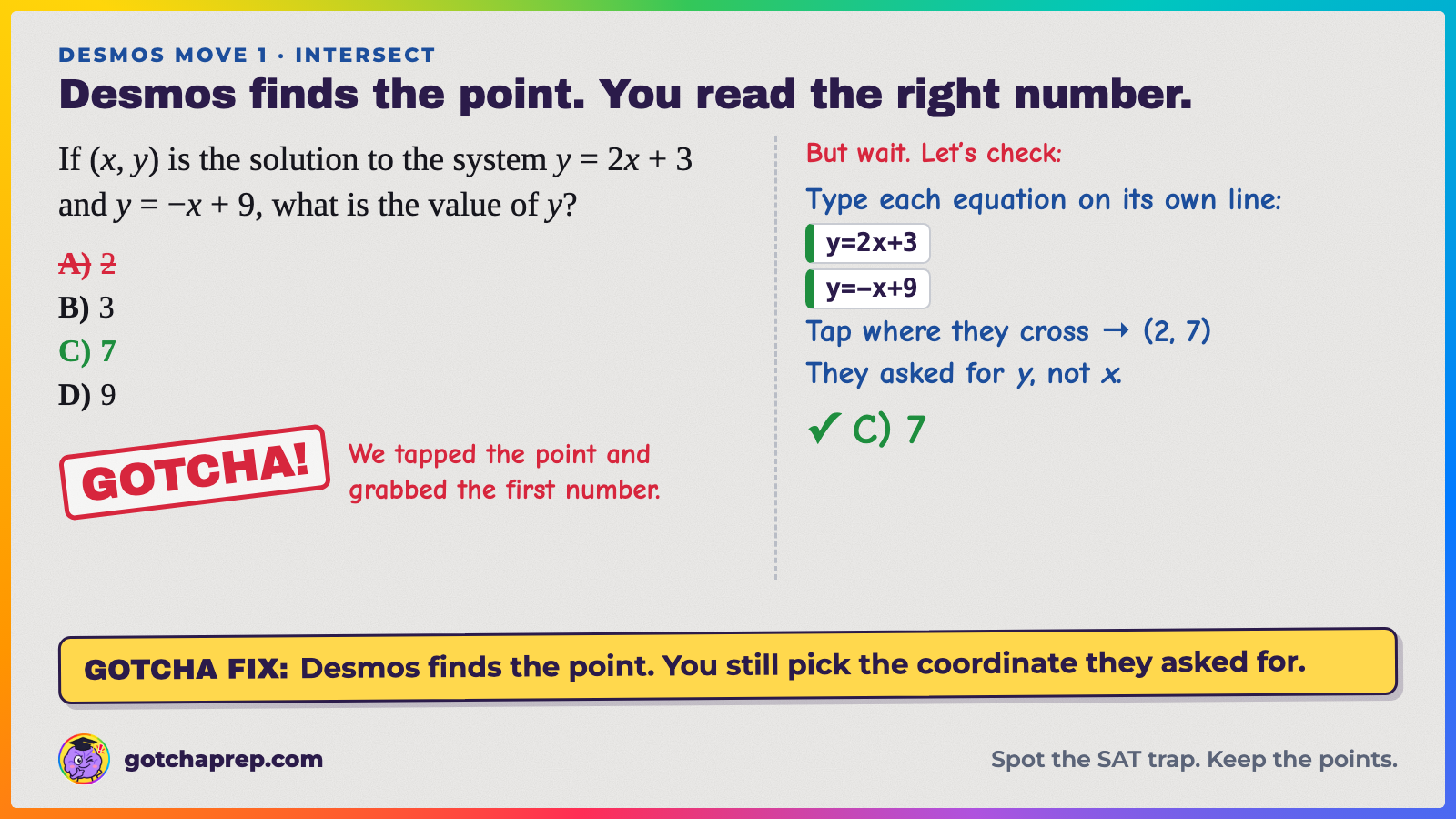
We tap the point, see (2, 7), and grab the first number: 2. But wait. The question asked for y. The answer is C) 7. Check: 2(2) + 3 = 7 and −2 + 9 = 7.
Rule: Desmos finds the point. You still pick the coordinate they asked for. Answer the question they asked
How do you find a line of best fit in Desmos?
Move 2: regression. Click the + button and add a table. Put the x-values in the x₁ column and the y-values in the y₁ column. On a new line, type exactly: y_1 ~ mx_1 + b
Desmos finds the best-fit slope m and intercept b and shows them under that line. For example, with the points (1, 12), (2, 19), (3, 31), (4, 38) and (5, 50), Desmos reports m = 9.5 and b = 1.5, so the line of best fit is y = 9.5x + 1.5. (By hand: the mean point is (3, 30), and the slope is 95 ÷ 10 = 9.5.)
The gotcha is one character: type = instead of ~ and Desmos offers sliders for m and b instead of a fit.
Rule: Best fit means tilde, not equals.
How do you find k with a slider?
Move 3: slider. Type the equation with k in it, tap "add slider," then drag k (or type values) until the graph does what the question describes.
Type exactly: y=x^2-6x+k. There's exactly one solution when the vertex touches the x-axis, at k = 9.
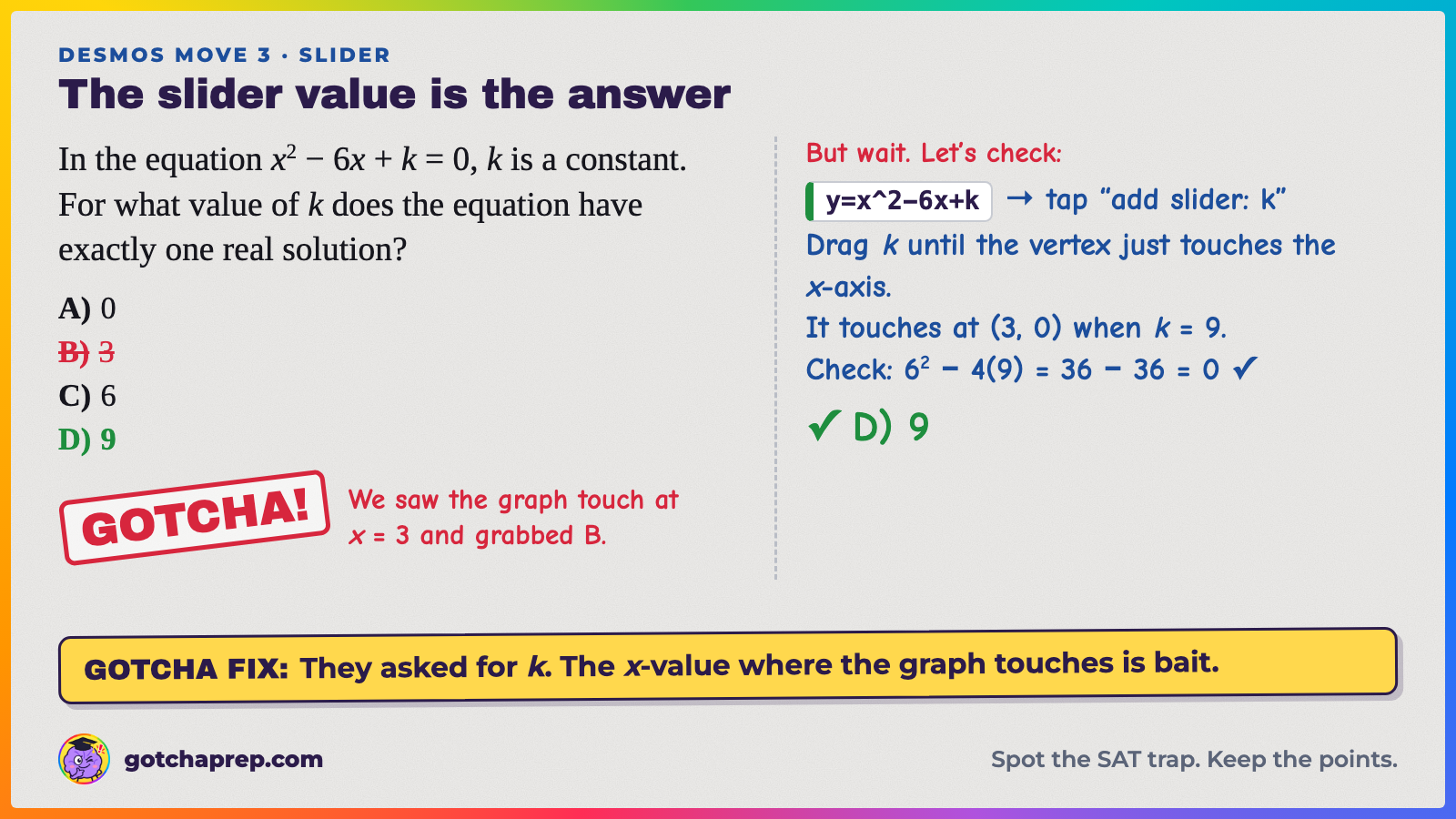
We watch the parabola touch the x-axis at x = 3, and 3 is right there in the choices. But wait. They asked for k, not x. The slider reads 9 when the vertex just touches the axis. The answer is D) 9. The discriminant agrees: (−6)² − 4(1)(9) = 36 − 36 = 0, so there's exactly one real solution.
Tip: tap the slider's number and type each choice. It's faster than dragging.
Rule: The slider value is the answer. The x-value where the graph touches is bait.
How do you count solutions with a graph?
Move 4: count crossings. Real solutions = the number of times the graph hits the x-axis (or two graphs cross).
Type exactly: y=x^2-4x+5. It never touches the x-axis, so there are 0 real solutions.
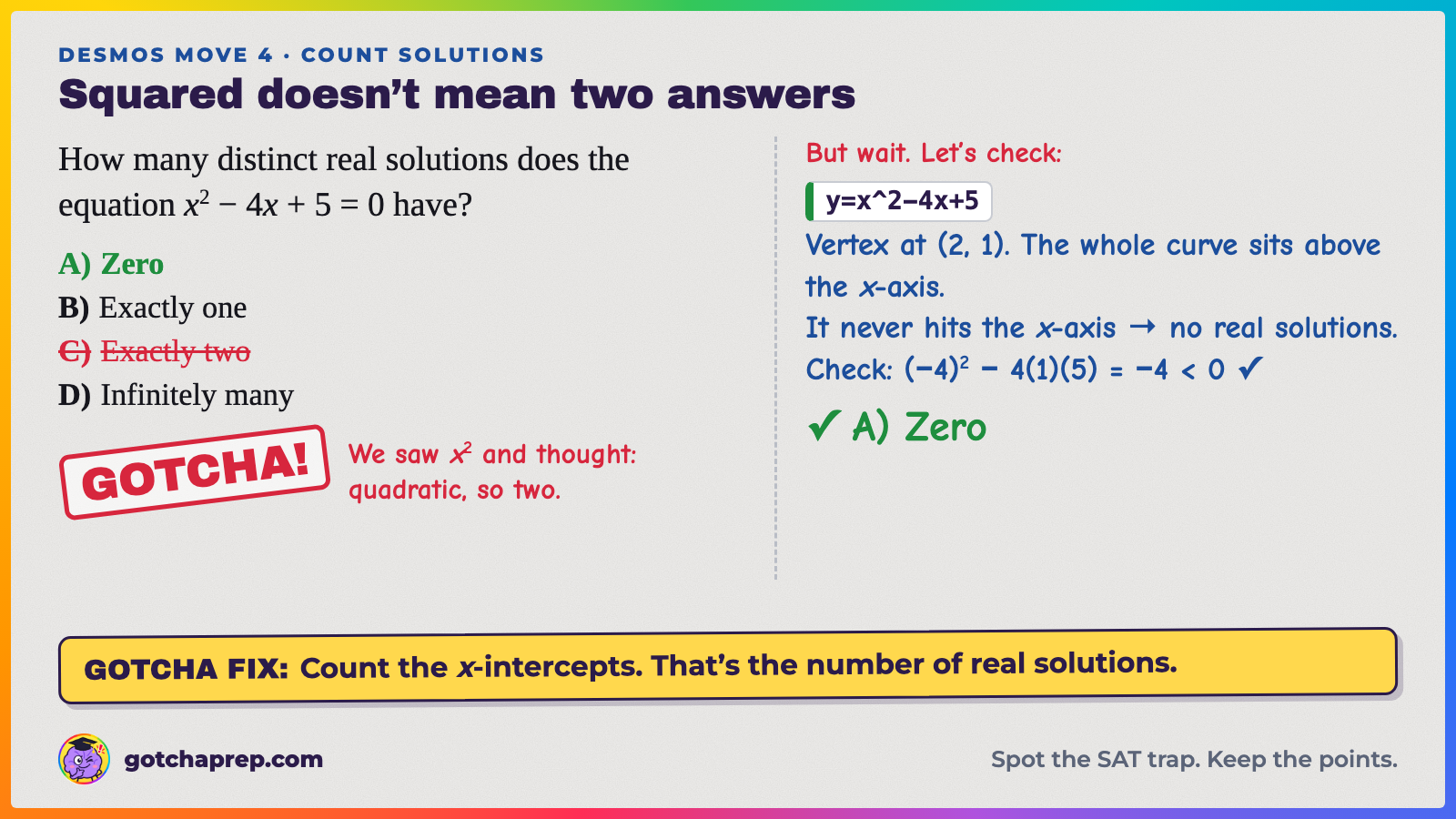
We see x² and think "quadratic, so two answers." But wait. The vertex is at (2, 1) and the parabola opens up, so it never reaches the x-axis. Zero crossings means zero real solutions: A) Zero. Check: (−4)² − 4(1)(5) = −4, and a negative discriminant means no real solutions.
Rule: Count the x-intercepts. That's the number of real solutions. No solution vs. infinitely many
How do you test answer choices with a table?
Move 5: table. Define the function, add a table, and type each answer choice as an x-value. The one that gives 0 (or the target value) wins. Faster still: type f(3) on its own line.
Type exactly: f(x)=x^3-2x^2-5x+6, then make a table with x = 2 and x = 3. Since f(3) = 0, 3 is a solution.
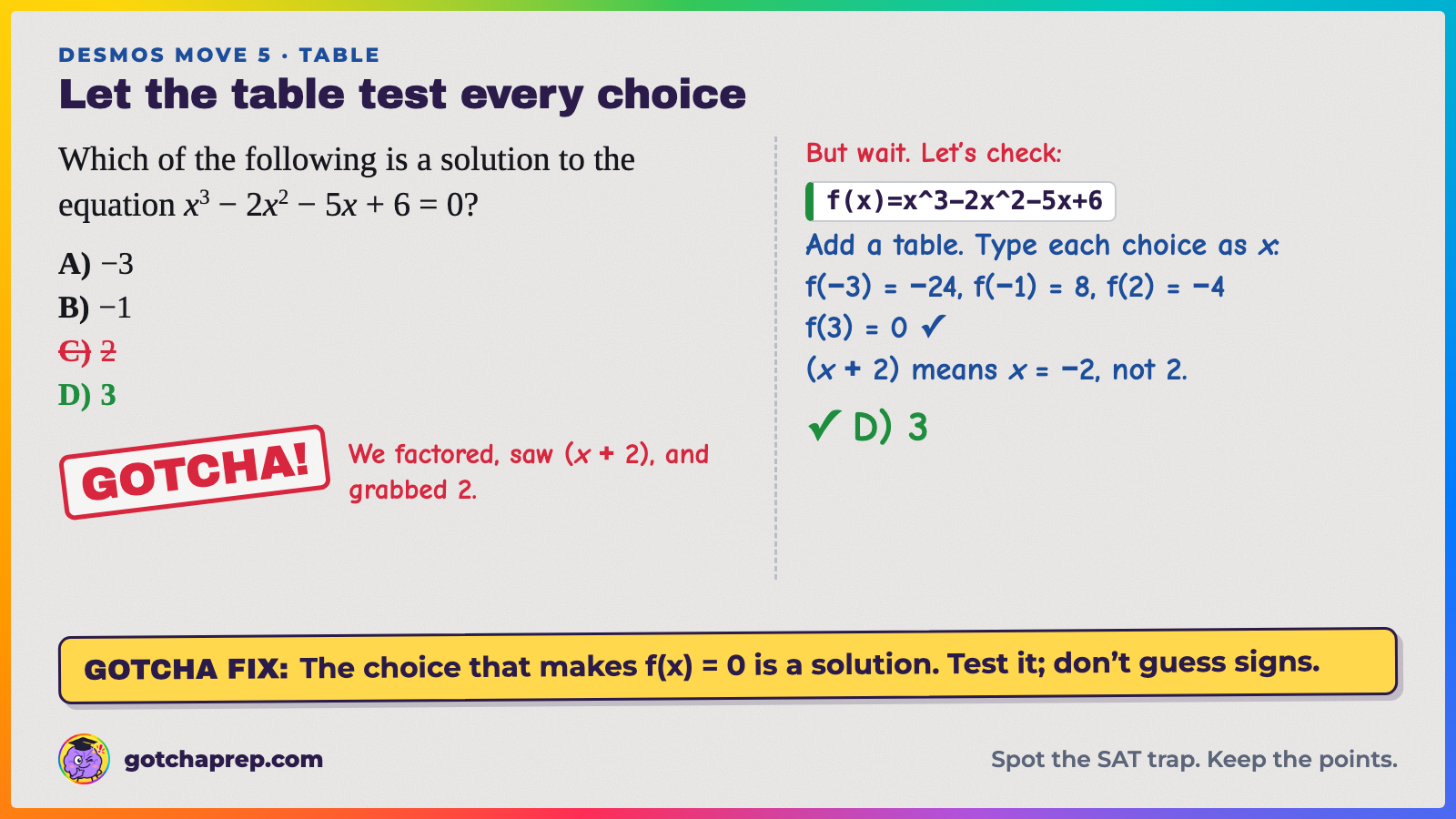
If we factor by hand, we get (x − 1)(x − 3)(x + 2), see the "+ 2," and grab 2. But wait. The factor (x + 2) means x = −2, not 2. The table settles it: f(−3) = −24, f(−1) = 8, f(2) = −4 and f(3) = 0. The answer is D) 3.
Rule: The choice that makes f(x) = 0 is a solution. Test it; don't guess signs.
When should you NOT use Desmos on the SAT?
Desmos is a tool, not a reflex. Skip it when:
- The algebra is one line. Solving 3x + 5 = 20 takes three seconds by hand. Typing it takes longer.
- They ask for an expression. If 3x + 5 = 20, what is 2x − 3? Desmos tells you x = 5, and you still have to finish: 2(5) − 3 = 7.
- The hard part is the setup. Word problems, units and "which equation models…" questions are reading problems first. Desmos can't read.
- There's nothing to graph. Plenty of geometry and statistics questions need a formula, not a graph.
- Desmos gives a decimal and the choices are exact. Desmos shows 2√3 as 3.4641… Type the choices (like
2sqrt(3)) to compare, or simplify by hand.
On fill-in questions, enter 2/3 as a fraction, not a short rounded decimal like .67, which can be marked wrong.
Rule: Let Desmos do the algebra. Never let it do the reading.
What else do students ask about Desmos on the SAT?
Is Desmos allowed on the SAT?
Yes. Bluebook, College Board's testing app, has a built-in Desmos graphing calculator on every math question, and you can also bring an approved calculator. Practice with it during Bluebook practice tests or at desmos.com.
What do you type for a regression on the SAT?
Make a table with x₁ and y₁ columns, then type y_1 ~ mx_1 + b on a new line. Use the tilde (~), not an equals sign. For a quadratic fit, type y_1 ~ ax_1^2 + bx_1 + c.
Can Desmos solve every SAT math question?
No. It's great for systems, graphs, regressions and testing choices. It can't tell you what the question is asking, and that's where most points are lost.
Where can you get all five Desmos moves on one page?
The free SAT Gotcha Sheet has all five Desmos cheat codes with the exact inputs, plus 30 trap cards. Get the free SAT Gotcha Sheet
Our Desmos guide walks through each move, and new Desmos Shorts land on Gotcha Prep's YouTube channel.
One rule to remember: Desmos answers the equation. You answer the question.
Gotcha Prep is not affiliated with College Board or Desmos. SAT® is a trademark registered by College Board, which does not endorse this article. Desmos and Bluebook are named only to describe the tools in the test. All practice questions are original.